Nudge
Nudge argues that the way choices are structured and defaulted quietly shapes our behavior far more than information or incentives, and that small design tweaks can steer better decisions without taking away freedom.
You’re handed a form at work and told you can join the pension plan if you tick a box; you mean to, you don’t, and years pass. In another office, the same form quietly says you’re already enrolled unless you untick the box, and almost everyone “chooses” to save. No one debated, researched, or changed their mind; the structure of the choice did the work. This book sits inside those small design decisions—on forms, in apps, in public policy—and asks how much of what feels like free choice is really just following the path already laid out.
Who this book is for, and who it is not for
If you feel your days are ruled by autopilot and you cannot understand why you keep drifting into the same financial, health, or productivity ruts, Nudge will give you a vocabulary and set of levers you probably have not seen before. It is especially useful if you design experiences for others: managers setting policies, product builders designing flows, parents shaping kids’ environments, or anyone trying to make their future self’s life easier. Readers already curious about behavioral economics who want to see how the ideas translate into concrete policy and product design will also find a lot to chew on.
If you want a motivational manifesto or a warm, story-driven self-help book, this will feel dry and policy heavy. It was written by economists and legal scholars, not coaches. Skeptical libertarians who distrust any government role in shaping behavior may also bristle at its policy recommendations, though the authors work hard to defend their “libertarian paternalism” label. Readers who expect a tight narrative arc following a single protagonist will likely bounce off the academic tone and dense policy case studies. If you have already read deeply in behavioral economics, much of the material will be familiar rather than surprising.
Why defaults quietly run your life
The central claim of Nudge is that default options are not neutral. When a choice architect decides what happens if you do nothing, they are effectively choosing for most people, most of the time.
Richard H. Thaler and Cass R. Sunstein show this with retirement savings. In many US companies, employees used to be offered 401(k) plans but had to opt in. Participation rates hovered around half, even when employers offered generous matches. When companies shifted to automatic enrollment, with the same contribution rates and investment options but a different default, participation shot up to around 90 percent. Nothing about the economics changed, only the path of least resistance.
The same pattern shows up in organ donation. Countries with default opt-in to donation have dramatically higher donor rates than otherwise similar countries that require active registration. People interpret the default as a recommended course of action, and many simply do not get around to changing it.
For personal habit design, the lesson is pointed: your “defaults” at home and work are making more of your decisions than your stated goals. The snacks at eye level in your kitchen, the app icons on your home screen, the way your paycheck is routed, the bedtime implied by your evening routine, all function as defaults. If you are trying to craft a life more aligned with your values, it makes sense to pair this with work on decision fatigue and pre-commitment, not just more willpower.
Choice architecture in the wild: from lunchrooms to savings plans
Choice architecture is the practice of designing how options are presented, in what order, with what information and framing. The authors argue that choice architecture is inevitable, so it might as well be used consciously and ethically.
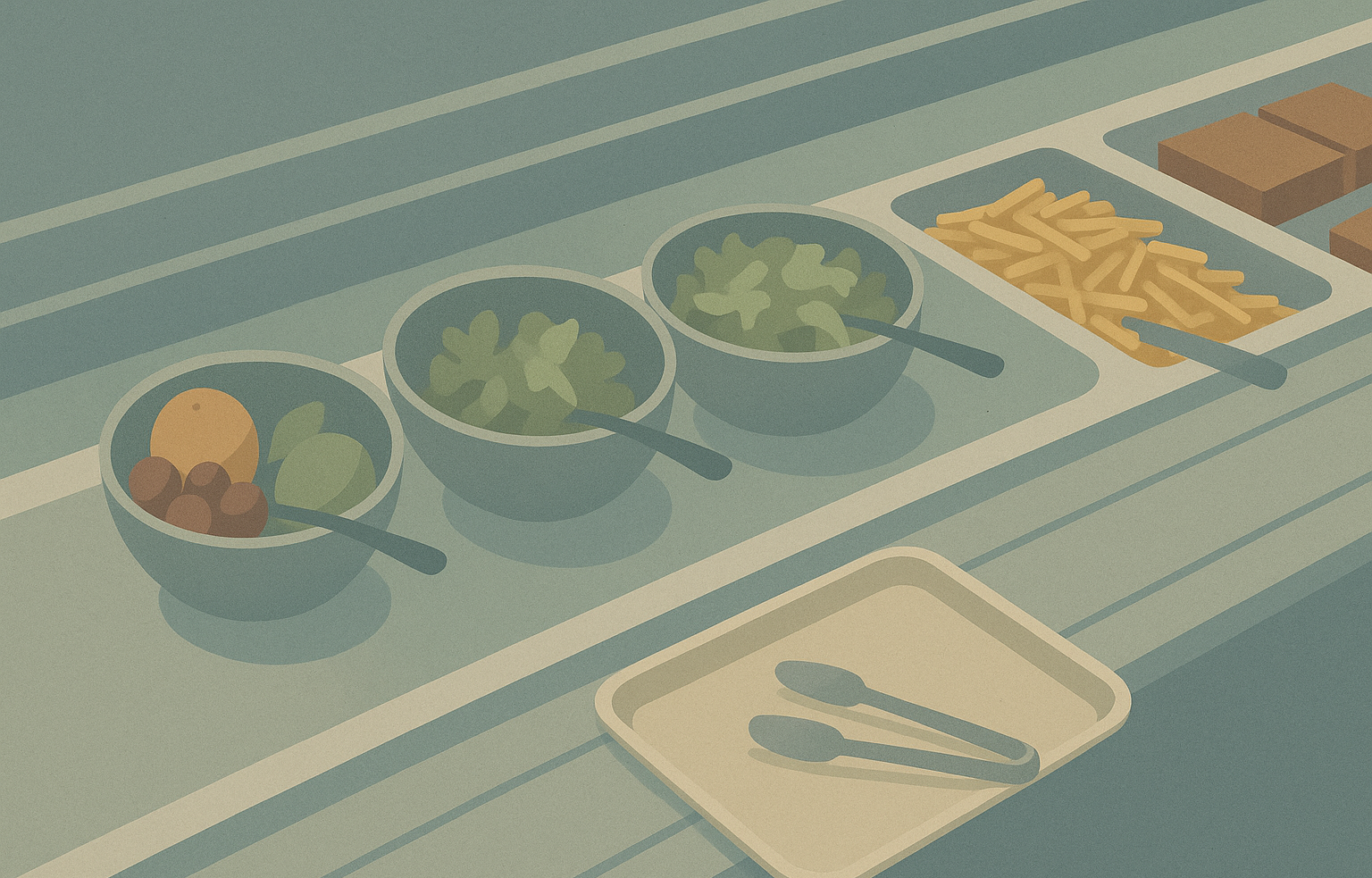
One example comes from school cafeterias. Simply rearranging the order of food so that fruit and salad appear before fries and desserts changes what children select, even though every item remains available. No bans, no lectures about health. Just a reshuffled line that results in more balanced trays and fewer sugary choices.
They explore “Save More Tomorrow,” a retirement plan design that asks workers to commit in advance to saving a portion of their future raises. People are loss averse and hate feeling their paycheck shrink, but they are open to the idea of not expanding their lifestyle as much later. By tying increases in contribution rates to future raises and making that the default, savings rates rise significantly without people ever feeling a painful cut.
At a more mundane level, they discuss how a simple fly etched in urinals at Amsterdam’s Schiphol Airport reduced spillage, because men unconsciously aimed at the target. It is a small, almost comical example of the same logic: visual salience and implied suggestions can steer behavior, even when no one thinks they are being influenced.
For your own life, this suggests looking at the “interface” around your key decisions. Where do you make food choices, work choices, spending choices? What is shown first? What takes effort? A cluttered desk and a chaotic browser may be a choice architecture that guarantees distraction. Systems like single-tasking and deep work make more sense when you see them as intentional redesigns of the choice environment, not just discipline tricks.
Libertarian paternalism: helping without coercing
Thaler and Sunstein describe their philosophy as “libertarian paternalism.” It sounds like an oxymoron, but they mean two straightforward things.
The libertarian side is that all options remain available. A nudge changes the path of least resistance, not the set of rights. You can opt out of automatic enrollment, pick the fries instead of the fruit, or choose an unusual mortgage, but the default and framing lean toward outcomes most people would endorse for themselves.
The paternalist side is that many people make predictable mistakes that harm their own long-term interests, often due to limited attention, present bias, and confusion. If a cafeteria must choose some ordering of food, or a pension system must choose some default, they argue it is better to pick the ones that help typical people save more, eat better, or avoid hidden legal traps.
The book spends many chapters applying this philosophy to government policy: energy bills that show your usage compared with neighbors, mortgage disclosure forms that highlight total lifetime costs, laws that require “cooling-off” periods for high-pressure sales. These are all built on the same belief that small design choices can protect people from their own predictable missteps while preserving freedom.
For self-development, this is a reframing of self-control. Instead of treating your present self as an enemy of your future self, you can be a gentle paternalist to your own life. Set up default calendar events for exercise, structure your checking and savings accounts so that “doing nothing” means money flows where you want it, and organize your digital environment to make your best choice the easiest one.
When information is not enough
A quieter but important theme of Nudge is that information campaigns underperform because they ignore how people actually decide. Telling people to save more, eat less, or drive safely rarely shifts behavior on its own.
The authors describe how credit card late fees and overdraft charges often stem not from ignorance of the rules but from inattention and procrastination. People know they “should” pay on time, yet they forget or avoid dealing with it. Automatic payment, alerts before due dates, and simplified statements do more to reduce fees than thick disclosure documents.
They build on their previous work on mental accounting and loss aversion to argue that people respond more strongly to how outcomes are framed than to their objective size. A health program described as preventing deaths is more compelling than one described as increasing survival rates by the same amount. A savings plan framed as “losing” part of your employer match if you do not contribute enough is more motivating than the equivalent “gain.”
In one experiment they discuss, giving people a simple, prefilled savings form with recommended contribution levels led to higher savings than just explaining tax advantages and letting them design a plan from scratch. The recommended numbers and concrete form changed behavior more than rational argument.
This has direct implications for personal growth work. It is tempting to read one more article about “the power of goal setting” and tell yourself you have solved the problem. Thaler and Sunstein would say that the form of your choices still dominates. Until you make changes at the level of contexts, reminders, defaults, and comparisons, knowledge alone is running uphill.
The honest caveat: where nudging overreaches
For all its influence, Nudge does draw criticism and has limits. The first issue is that not all behavior can be gently steered into place. Problems rooted in structural inequality, deep addiction, or strong social norms are not going to move much because of a clever disclosure box or a better default. The book at times leans too quickly to design tweaks where more direct interventions might be necessary.
A second concern is the power of the choice architect. Even with the authors’ emphasis on transparency and freedom to opt out, someone must choose which outcomes to favor. In political contexts, that someone may have conflicting interests, ideological biases, or commercial incentives. Critics worry that once the idea of nudging is normalized, it becomes easier to justify subtle manipulation for goals that are not so benign.
There is also mixed empirical evidence about how durable some nudges are. Defaults often work very well, but social norm messages and framing effects can fade as people adapt or learn to game them. Replications in behavioral science have shown that not every reported effect is as large or reliable as initial studies suggested. Nudge sometimes presents these results in a more confident, sweeping way than later evidence supports.
For personal development readers, the main caveat is that environment design helps, but it does not remove the need for reflection, values work, and sometimes hard tradeoffs. If you treat nudges as magic levers, you may neglect deeper work on why you are pursuing certain goals in the first place.
Where to start in the book
If you want the essence of Nudge without reading every policy example, begin with the introductory chapters that define choice architecture and libertarian paternalism, then move straight to the sections on retirement savings and the “Save More Tomorrow” program. After that, the chapters on privatizing Social Security and healthcare can be sampled rather than studied, unless you are deeply interested in policy design.
A skim through the chapter on “Objections” is worthwhile because it engages directly with common criticisms and will sharpen your own thinking. You can safely treat some of the later, more technical policy chapters as optional and focus on the recurring structure of examples: identify a predictable bias, then see how a small design change can work with it rather than against it.
“Small and apparently insignificant details can have major impacts on people’s behavior.”
— Richard H. Thaler and Cass R. Sunstein