Atomic Habits
Atomic Habits argues that identity-based change, built from tiny behaviors that run through a cue–craving–response–reward loop, outperforms chasing outcome-based goals.
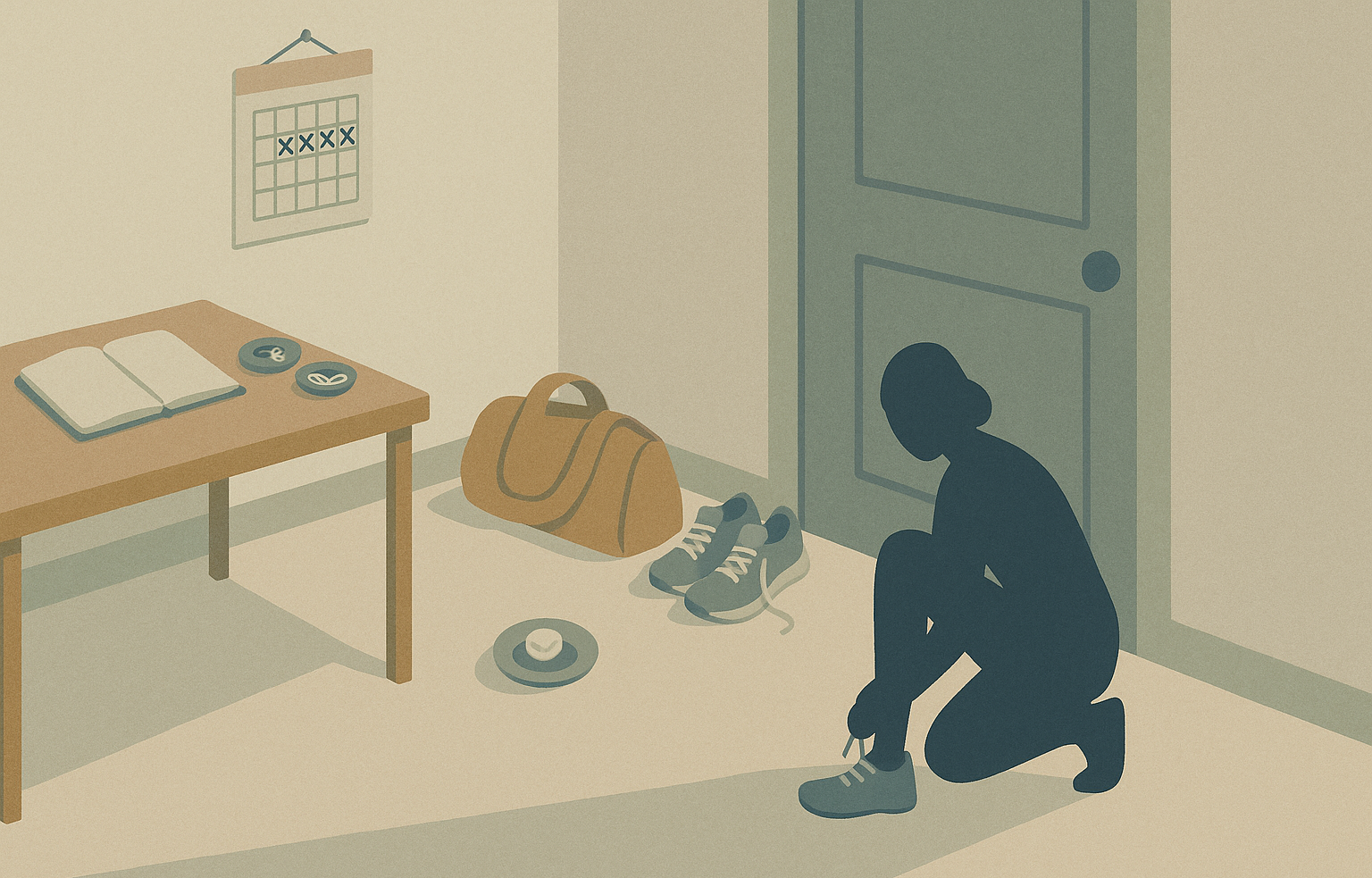
You close the door after another long day and notice the same small trail of evidence: shoes dropped in the hallway, a half-finished to-do list, the running shoes still by the door. None of it feels dramatic, but it quietly confirms a story you already tell yourself about who you are and what you’re “just not good at.” James Clear’s argument is that these little moments are not background noise; they are the material from which a different identity can be built. This summary explores how tiny, well-designed habits can begin to rewrite that story.
Who this book is for — and who it is not for
Atomic Habits is for people who feel stuck in a loop of “big goals, short bursts of effort, quiet backslide.” If you keep setting targets for fitness, focus, or creative work and then losing steam, James Clear gives you a simple grammar for behavior: cues, cravings, responses, rewards. The book shines for readers who like practical structure and concrete examples more than abstract theory.
It is also a strong fit if you already know roughly what you want but cannot make your daily actions match your intentions. Anyone building a side project, recovering from burnout, or trying to rebuild confidence after repeated failures will find his “small wins” philosophy grounding.
This is not a great fit if you expect deep neuroscience, primary research, or a heavy philosophical discussion of free will and behavior. It is also limited for readers who already live happily with loosely defined routines and do not feel much friction around habits. If you have already read several behavior-change books and routinely design systems for yourself, the frameworks here will feel familiar, even if the packaging is polished.
Identity: becoming the kind of person who does the habit
The most important move in Atomic Habits is the shift from outcome-based goals (“run a marathon”) to identity-based habits (“be a runner”). Clear argues that lasting change comes from asking, “Who is the kind of person who can get this result?” and then letting each small action be a “vote” for that identity.
He contrasts two people offered a cigarette. One says, “No thanks, I’m trying to quit.” The other says, “No thanks, I don’t smoke.” The behavior is the same, but the self-story is different. In the second case, the habit is no longer a fragile project; it is part of who the person is.
The book returns repeatedly to this theme. A person who wants to write a book focuses on “being a writer” who sits down every day, not on “finishing 80,000 words.” A person who wants to get organized focuses on “being the kind of person who does not leave decisions to the last minute,” which fits neatly with the idea of protecting willpower that we explore in Decision Fatigue and How to Reduce It.
Clear’s core claim is that identity, processes, and outcomes form a loop in that order. We usually start with goals and hope they change us. He inverts that: start with identity, design systems that reinforce it, and let outcomes accumulate almost as a side effect.
The four laws: redesign your environment, not your willpower
The book’s framework rests on the cue–craving–response–reward loop, drawn from behavioral psychology. To change behavior, Clear packages the science into “Four Laws of Behavior Change”:
- Make it obvious.
- Make it attractive.
- Make it easy.
- Make it satisfying.
Rather than give theories, he piles on small, vivid tactics. To “make it obvious,” he suggests habit stacking: tie a new habit to an existing one. “After I make my morning coffee, I will write one sentence in my journal.” He describes how he placed a bowl of paper clips on his desk while making sales calls. Each completed call moved one clip to another bowl, turning an invisible process into a physical signal of progress.
To “make it attractive,” he recommends temptation bundling. One example is a reader who allowed herself to watch Netflix only while on the exercise bike. The craving for entertainment pulls the habit of movement along with it.
“Make it easy” runs against the heroic self-image many of us carry. Clear dissects stories of high performers and keeps arriving at the same pattern: they lower friction. He writes about leaving his gym bag by the door, preparing workout clothes the night before, and even choosing a gym that was on his commute so that not going would require an extra decision.
“Make it satisfying” leans into our short-term bias. Because big rewards like “better health” are delayed, he encourages immediate cues of success: tracking a habit on a calendar, transferring a small amount of money into a “future self” account after each workout, or ending a workday by writing a brief note of what went well.
Across all four laws, the deeper lesson is that environment quietly outvotes willpower. If a bowl of nuts sits on the counter and the cookies are in the pantry, that redesign is worth more than another burst of determination.
Systems over goals: the compounding effect of tiny gains
Clear insists that “you do not rise to the level of your goals, you fall to the level of your systems.” Goals set direction; systems carry you there (or do not). To make this concrete, he uses a simple illustration: if you can get 1 percent better every day, you will be almost 37 times better after a year. If you get 1 percent worse, your capability collapses near zero.
This sounds like rhetorical math, but it lands when he walks through real cases. The British cycling team, Team Sky, was once notorious for poor performance. Manager Dave Brailsford focused on “aggregation of marginal gains”: tiny improvements everywhere, from redesigned bike seats to better handwashing to avoid illness. Over time those tiny edges compounded into multiple Tour de France wins and Olympic dominance.
Clear uses that story as a parable for personal life. You do not need a grand reinvention, you need small, repeatable upgrades in the systems that control your behavior: how you start your morning, how you lay out your workspace, how you handle the first urge to procrastinate.
He also makes an underappreciated point about plateaus. Early effort often shows little visible result. He likens this to heating an ice cube: nothing seems to happen as the temperature goes from 25 to 31 degrees, then at 32 degrees the cube suddenly melts. The breakthrough is not a miracle; it is the last step in a long chain. This helps explain why people abandon good habits just before they start to pay off.
If we imagine our lives as governed by quiet compounding, the question shifts from “What result do I want in three months?” to “What daily system can I design so that good results are almost inevitable over three years?”
Designing habits that survive real life: friction, tracking, and community
Atomic Habits is strongest where it anticipates human messiness instead of assuming we are rational optimizers. Clear treats “friction” as a design variable. To break a habit, you can add steps between you and the behavior. He describes one family that unplugged the television after each use and stored the remote in a drawer in another room. TV did not become forbidden; it simply became slightly more annoying, which cut mindless watching dramatically.
On the positive side, the “two-minute rule” suggests that any new habit should be scaled down to something that takes two minutes or less. Running becomes “put on my running shoes.” Reading becomes “open a book and read one page.” The point is to make starting so easy that you cannot rationally argue yourself out of it. Once you are in motion, extending the habit is far easier.
Habit tracking plays a motivational role in the book. Clear is fond of the phrase “don’t break the chain.” He tells the story of comedian Jerry Seinfeld marking an X on a calendar for every day he wrote jokes, creating a streak he did not want to disrupt. Clear used similar visual scoreboards to track his own writing, workouts, and publishing schedule.
Finally, the book explores social influence. We tend to mirror the habits of our “tribe,” so it matters whom we surround ourselves with. Clear encourages joining groups where your desired behavior is the normal behavior: a running club, a writers’ group, or a workplace where deep work is respected, echoing themes from our piece on Deep Work as a Daily Practice. Belonging makes good habits feel like alignment rather than struggle.
Where the book overreaches
Atomic Habits sits in the popular science category, and its clarity sometimes hides simplifications. While the cue–craving–response–reward loop is well grounded in behavioral research, Clear often presents studies and anecdotes as if they guarantee success if you apply the Four Laws. In reality, behavior change is constrained by genetics, mental health, socioeconomic context, and plain luck more than the book admits.
Some critics have noted that his stories about athletes, executives, and elite performers risk survivorship bias. We hear about the people who used small habits and succeeded, not those who applied similar strategies and still struggled because of injury, layoffs, or family obligations.
Habit tracking and streaks can also backfire. For certain readers, the “don’t break the chain” mindset creates anxiety and all‑or‑nothing thinking. Miss one day, and it feels as if the identity is broken. The book does acknowledge the value of recovering quickly, but the overall tone leans more optimistic than cautious about this risk.
Despite these limitations, the core message that environment and systems matter more than willpower remains useful. It just should not be mistaken for a universal law that overrides structural realities or individual differences.
Where to start in Atomic Habits
If you are browsing in a bookstore, read the opening chapters that introduce the idea of identity-based habits and the “1 percent better” argument. From there, skip directly to the chapters that outline the Four Laws of Behavior Change, especially the sections on habit stacking, the two-minute rule, and environment design. You can treat the numerous case studies as optional; skim them if you enjoy examples, but do not feel obligated to digest every story.
When in doubt, go back to the early sections on identity and systems and ask how they apply to one concrete area of your life right now rather than trying to overhaul everything.
Atomic Habits leaves you with a simple question: what tiny, repeatable behavior today would be a real vote for the person you intend to become next year?
Every action you take is a vote for the type of person you wish to become. — James Clear