The Zeigarnik Effect
Your brain clings to unfinished tasks and half-made decisions. The Zeigarnik effect explains why, and how a simple written list can finally quiet the noise.
The Strange Weight of Unfinished Stuff
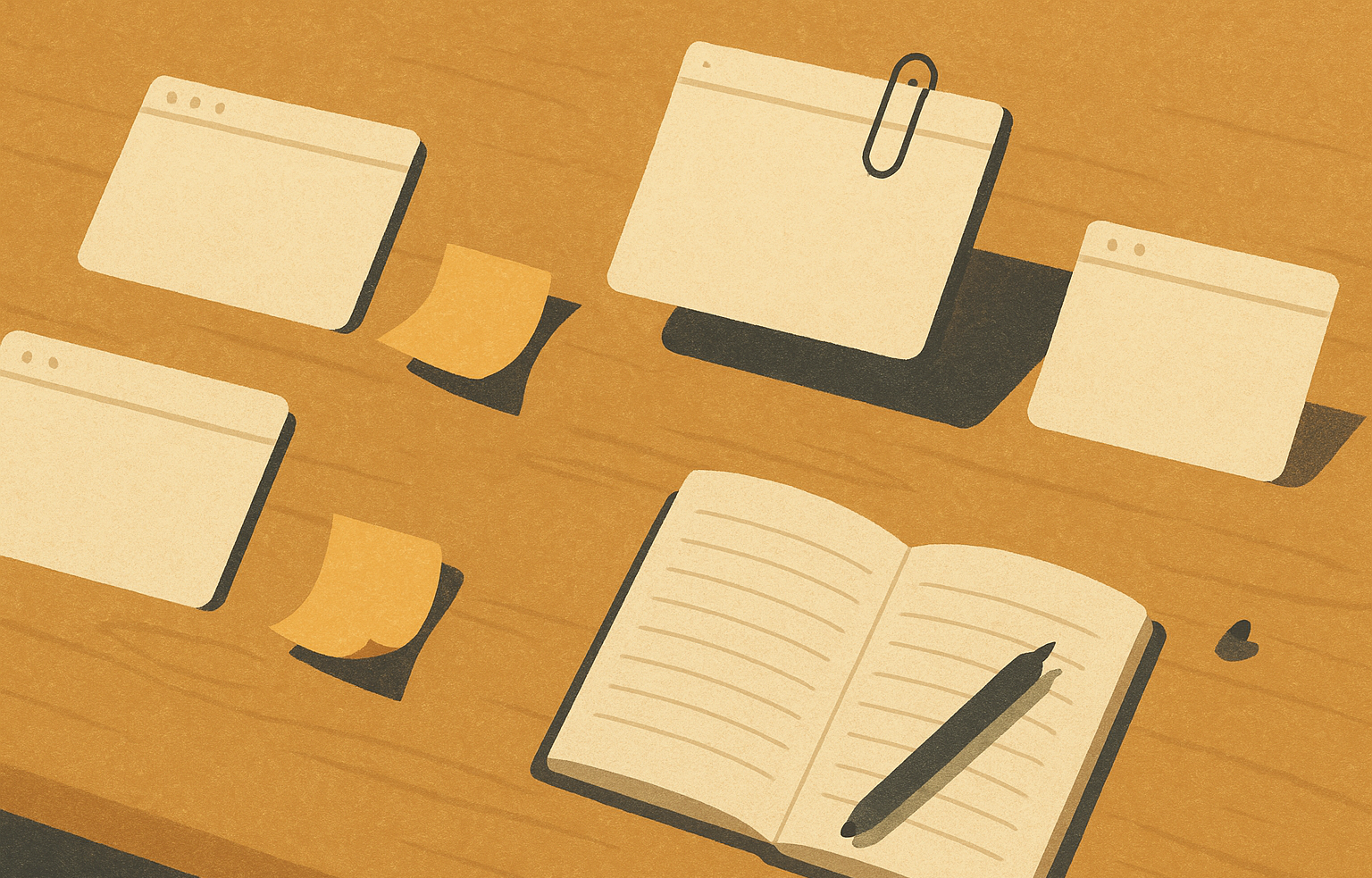
You sit down to relax, and your mind starts listing everything you did not complete: the email you half-wrote, the bill you meant to pay, the project outline still in draft. Your body is on the couch, but your attention is in ten different browser tabs.
There is a name for this mental tension: the Zeigarnik effect. Unfinished tasks hold your attention more strongly than finished ones. Your brain keeps them active, as if it is afraid they will vanish if it lets go.
That nagging is your brain asking for two specific things: a clear next step for each item, and a safe place to keep it outside your head.
Once you understand this, a boring habit like writing things down stops feeling like productivity theater and starts looking like a pressure valve for your mind.
What the Zeigarnik Effect Does to You
The Zeigarnik effect is simple: incomplete tasks and interrupted activities stay mentally sticky. Your brain flags them as unresolved, and they keep resurfacing.
You feel it in daily life:
- You turn off your laptop, then remember a message you meant to send, and now you are thinking about it while making dinner.
- You start cleaning your kitchen, get pulled into a call, and find yourself slightly agitated until you finish that last counter.
- You go to bed, and your brain suddenly delivers a highlight reel of every loose end from the day.
Bluma Zeigarnik first noticed this pattern while watching restaurant staff. When a bill was still open, the waiter could recall the order in sharp detail. As soon as the table paid, the details faded because the loop had closed.
You have your own version of those open tables:
- Draft emails
- Vague promises to “get coffee sometime”
- Half-made decisions
- Projects with no next step defined
- Personal errands you keep postponing
Each one is small, yet together they create constant low-level tension. Your brain keeps these items spinning because it wants closure, or at least a clear path to it.
The Zeigarnik effect works like a design rule of your attention. When you respect that rule, focus gets easier. When you fight it, you feel chronically behind, even on days when you work hard.
Why Your Brain Loves Closure (And Hates Vague Tasks)
Your brain works a bit like an overprotective project manager. Once it senses something unresolved, it keeps sending reminders until you either finish it or prove that you have a plan.
This is why a small, vague task can feel heavier than a large, specific one.
Take two items:
- “Sort out finances”
- “Log into bank, download last month’s statement, and flag unexpected charges”
The first one lingers for weeks. Every time you think of money, you get a brief jolt of anxiety. Your brain knows there is something to do, but it has no picture of what “done” looks like. There is no natural place to stop.
The second one is concrete. Your brain can imagine the steps and the endpoint. Once you complete it, the mental loop closes. The reminder quiets down.
This is the same reason Cal Newport puts so much emphasis on defining “what done means” for deep work sessions. Your mind relaxes when it knows what it is aiming for and when it can stop.
You feel the difference in three ways:
- Cognitive load. Vague tasks take up more mental space. You keep re-deciding what they mean.
- Emotional friction. Each reminder comes with a small dose of guilt or worry.
- Avoidance. The heavier a task feels, the more you delay it, which adds even more tension.
You cannot stop your brain from caring about loose ends, but you can feed it something it accepts as progress: a concrete next step, parked in a trusted place.
Why Writing It Down Actually Works
You might already keep lists and still feel overwhelmed. That usually means your lists are just storage, not a working partnership with your attention.
The Zeigarnik effect calms down when your brain believes three things:
- The task is captured.
- The next step is clear.
- You will see it again at the right time.
If any of those three are missing, the mental loop stays open. You can test this. Think of a small nagging task, like “book dentist appointment.” Now:
- Picture it only in your head. Notice the slight tension.
- Then write: “Tomorrow at 9:00, call Dr. Smith’s office to book checkup” in a place you actually check.
- Add a tiny reminder on your phone for 8:55.
You will usually feel an immediate drop in mental pressure. Nothing is finished yet, but your brain accepts the written plan as partial closure.
This is why systems like Getting Things Done often feel like a relief once you use them properly. Using lists becomes a way to give your memory a reliable home that it can relax into.
A written list works when you treat it like an external mind:
- It holds the unresolved items.
- It spells out the next visible action.
- It reassures your brain that nothing important will vanish.
The habit that matters most is one simple rule: every time a task crosses your mind more than twice, capture it in writing with a specific action and a likely when.
Once that rule becomes automatic, the Zeigarnik effect starts working for you instead of against you. Your brain raises the flag, you write, then both of you can rest.
Turning Loose Ends Into Clear Next Steps
You might think of your attention as a desktop with limited space. Unfinished tasks are open windows. Writing them down with clear next steps is like minimizing them and stacking them neatly.
You can turn that image into a simple practice without turning your life into a constant planning exercise.
1. Do a “mental tab dump”
Spend ten minutes and list every open loop you can think of:
- Work projects waiting on you
- Messages you owe
- Health errands
- Home repairs
- Conversations you keep postponing
- Ideas you want to explore
Do not organize yet. Just get them out of your head.
2. Turn each item into a visible action
For each line, ask: “What is the very next thing a camera could see me do?”
Examples:
- “Get in shape” becomes “Search for a nearby gym and bookmark three options.”
- “Fix relationship with my brother” becomes “Send him a short message asking if he is free this weekend.”
- “Finish client report” becomes “Open report draft and write bullet points for section three.”
This shift from outcome to action is what lets your brain relax. The loop now has a clear first step.
3. Decide when, even roughly
You do not need exact timestamps for everything, but you do need a general bucket:
- Today
- This week
- This month
- Someday (for ideas, not obligations)
Write the bucket next to each action. If something cannot reasonably fit into any of those without crowding your life, it is a sign to renegotiate or drop it.
4. Trim fake obligations
Some open loops exist only because you once said “maybe.” They sit on your list as if they are mandatory, but they are optional.
Scan your list and ask:
- “If this quietly never happened, would my life actually suffer?”
If the honest answer is no, drop it. Your attention is already expensive. Do not spend it on tasks that only survive out of habit or guilt.
This step is where a lot of relief hides. You release yourself from being the maintainer of every idea you have ever had.
Using Journaling To Clear Residual Noise
Lists handle tasks. Journaling handles the emotional residue around them.
The Zeigarnik effect covers more than the actions you have not taken. It also latches onto conversations you replay, decisions you doubt, or paths you did not choose. Your brain counts those as unfinished too.
A short written debrief helps you create a sense of mental closure, even when nothing in the outer world changes yet.
You can keep this simple:
Name the loop.
”I keep thinking about the feedback my manager gave yesterday.”Describe what still feels open.
”I am unsure what exactly she wants changed. I also feel embarrassed about missing it.”Write one concrete next step.
”Tomorrow I will ask her for one example of the change she has in mind.”Add one sentence of perspective.
”This is uncomfortable, but it is a chance to get clearer and improve.”
This pattern turns a spinning thought into a small plan. Your brain stops throwing it at you every hour because it has been acknowledged and anchored.
If you already journal, you can add one prompt at the end of each entry:
“Which thought keeps returning tonight, and what is the smallest action that would give it some closure?”
Over time, this becomes a quiet form of self-maintenance. You tune your inner environment, not just your calendar.
For more on using writing this way, see the power of journaling for prompt ideas, and the two-minute rule for small structural tweaks that relieve the same kind of mental friction.
What to Try Tomorrow
Tomorrow morning, before you open your inbox or check your phone, take one blank page and write down every unfinished task or nagging thought that pops up in three minutes, then pick just one and define a single concrete next action for it with a rough when.