Implementation Intentions
Your goals stay vague until you decide exactly when and where they will happen. Implementation intentions turn that decision into a simple if-then script.
Why Vague Intentions Keep Dying
You tell yourself you will exercise more, read before bed, stop checking your phone so much, then a week later nothing has changed except a bit more frustration with yourself. Your day pulls you along, and by the time you think of the habit, the window for it has already passed. The intention was real. The plan was foggy.
A stalled habit rarely dies from a lack of desire. It dissolves in the gap between “sometime” and “this exact moment, in this exact place, in this exact way.” That gap is where implementation intentions come in.
What Implementation Intentions Actually Are
An implementation intention is a very specific if-then plan: “If situation X happens, I will do behavior Y.” Instead of carrying around a loose goal, you pre-load a small script into your mind.
You already use crude versions of this everywhere:
- If the traffic light turns green, you press the accelerator.
- If the kettle whistles, you turn off the stove.
- If your phone buzzes, you reach for it.
Those behaviors run almost automatically because the cue and the response are tightly paired by repetition. Implementation intentions borrow that pattern on purpose. You decide the cue and the exact response ahead of time, so your brain has less to negotiate in the moment.
For example:
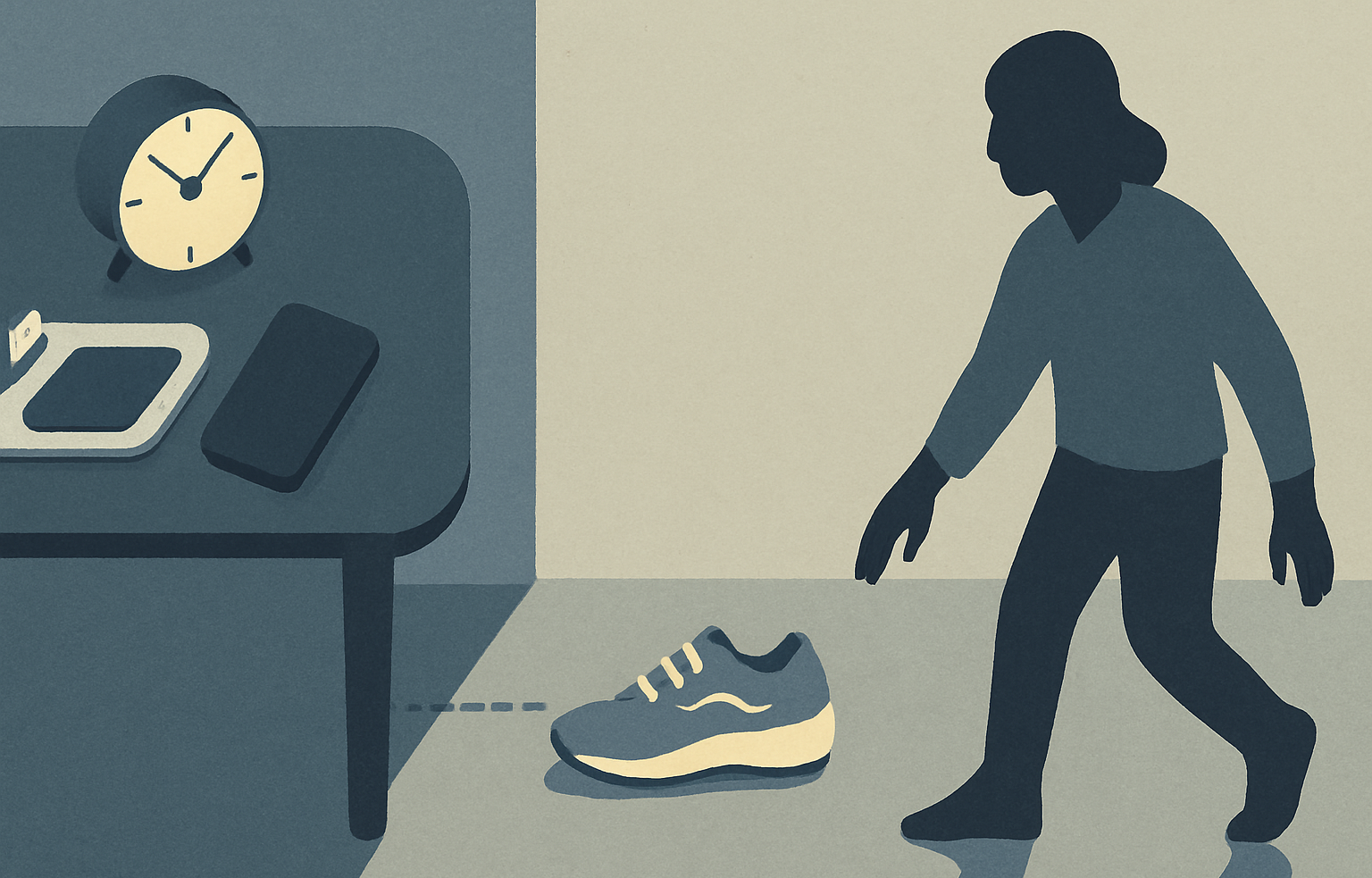
- “If it is 7:15 a.m. on a weekday and I have finished brushing my teeth, I will put on my running shoes and walk for ten minutes.”
- “If I sit down at my desk after lunch, I will open my calendar before I open email.”
- “If I feel the urge to check social media while working, I will write one sentence on my current task first.”
- “If I finish dinner, I will put my plate straight into the dishwasher.”
- “If I hang up from a work call, I will take one note about what I promised.”
This is smaller and more concrete than goal setting, and more pointed than general habit talk. It is a tiny contract with yourself that attaches a behavior to a trigger you can actually recognize during your real day.
James Clear popularizes this pattern through phrases like “I will [behavior] at [time] in [location].” Underneath that structure is the same idea: you choose a clear if, and bind it to a clear then.
Why This Simple Pattern Works So Well
On the surface, writing “If X, then Y” looks almost too simple. You might already think in those terms loosely. The difference is that when you spell it out, you solve several hidden problems at once.
1. You remove decision fatigue
When you reach the moment of action without a script, you have to think:
- Do I do it now or later?
- Where should I start?
- How long should I spend?
Each question is a tiny drain on willpower. If your day is already full of choices, you will often pick the easiest answer: “later.” With a pre-made implementation intention, the moment you hit the cue, the decision is done. All that is left is to follow the script, or consciously break it.
You can feel the difference on a day when you plan dinner compared to a day when you stand in front of the fridge hoping for inspiration. Implementation intentions are the mental version of having ingredients ready on the counter.
2. You shrink the habit to the first visible move
Vague goals feel heavy. “Exercise three times a week” carries every past failure and every image of the ideal version of you. That weight makes it harder to start.
An implementation intention focuses on the starter move: “If it is 7:15 a.m. and my teeth are brushed, I put on my running shoes.” You have not promised a perfect workout. You have promised the first visible action.
Often, once you are in motion, continuing feels easier than stopping. If it does not, you can still count the small action as a win and build from there. This pairs well with BJ Fogg’s focus on tiny habits, where the minimum version of the behavior is almost laughably small.
Each small win is also a chance to feel like someone who shows up instead of someone who constantly postpones. That identity shift is worth more than any single workout or study session.
3. You connect habits to your real environment
Your brain works in specific rooms, with specific chairs, mugs, screens, and doorways, far more than it works in abstract plans. By tying your behavior to a real context, you give it something concrete to hook onto.
This is where many habit plans fall apart. You write a list in a notebook on Sunday, then shut the notebook and go live in a different environment all week. Implementation intentions ask, “Where exactly will this live?” and “What exact moment will flip it on?”
You might notice that you are more likely to snack when you stand in a certain part of your kitchen, or that you always open a social app when you sit in a certain spot on the couch. Your environment is already full of unspoken if-then scripts. You are just writing them down on purpose.
4. You surface friction ahead of time
When you sit down to write “If X happens, then I will do Y,” you quickly notice where your plan is unrealistic:
- “If I finish work at 6 p.m., I will cook a healthy dinner from scratch every night.” Except you rarely finish at 6.
- “If I wake up, I will read for an hour before checking my phone.” Except you use your phone as your alarm.
- “If I get home from the gym, I will prepare lunches for the next day.” Except you arrive home exhausted and starving.
The act of specifying the conditions reveals conflicts and frictions. You can adjust the plan while you are calm, instead of discovering the problem when you are tired and rushed.
Sometimes that adjustment is humbling. You realize the only realistic reading time is ten minutes on the train, not an hour in a perfect chair. Smaller and specific usually beats grand and vague.
How To Design Implementation Intentions That Actually Stick
You can write an if-then sentence in ten seconds. Writing one that survives a messy week takes a bit more thought. Use this as a simple design checklist.
1. Make the “if” unmistakable
A good cue is:
- Visible. You can notice it without effort.
- Specific. It is one clear event, not a vague mood.
- Frequent enough. It happens often enough to give you repetitions.
Stronger cues often come from:
- Existing routines: brushing your teeth, turning off your alarm, making coffee, sitting at your desk.
- Time and place: 8:30 a.m. at the kitchen table, 9 p.m. in bed.
- External events: closing your laptop at the end of the day, parking your car, hanging up from a call.
Weak cues sound like:
- “If I feel motivated…”
- “If I have time…”
- “If I remember…”
Those are wishes dressed up as cues. Anchor your habit to something outside your shifting mood.
If you are unsure whether your cue is clear enough, imagine explaining it to a friend who follows you around. Would they know exactly when to tap you on the shoulder and say, “Now”?
2. Make the “then” small and concrete
Your then is a behavior you can finish in 30 to 120 seconds, especially at the start. That does not mean you cannot do more. It means you only have to do that much to count the intention as kept.
For example:
- Instead of “If I get home, I will read for an hour,” try “If I put my bag down at home, I will open my book and read one page.”
- Instead of “If I wake up, I will meditate for twenty minutes,” try “If I wake up, I will sit on the edge of my bed and take five slow breaths.”
- Instead of “If I finish dinner, I will clean the whole kitchen,” try “If I finish dinner, I will wash one pan.”
This makes breaking the chain feel silly. Skipping five breaths is harder to justify than skipping a full session, because the cost is so low. Over time, you can let the behavior naturally grow.
A concrete then also makes it easier to notice when you have succeeded. “Be healthier” has no clear end point. “Eat one piece of fruit after lunch” does.
3. Tie new behaviors to solid anchors
You already have dozens of rock-solid habits: flushing the toilet, washing your hands, locking the door, opening your laptop. These are stable anchors.
Habit stacking, which James Clear describes in Atomic Habits, is basically a chain of implementation intentions: “After I do current habit X, I will do new habit Y.” This piggybacks your new behavior onto something that is already reliable.
For example:
- “If I pour my morning coffee, I will write one line in my journal.”
- “If I close my work laptop, I will set out my gym clothes.”
- “If I finish brushing my teeth at night, I will plug in my phone in the kitchen.”
- “If I sit down on the train, I will open my language app instead of my inbox.”
The anchor keeps the cue stable. The small behavior keeps the cost low. Together, they give your plan a better chance than yet another lonely to‑do item.
There is a limit, though. If you attach three new behaviors to the same anchor, you dilute its power. One anchor, one new habit is usually plenty.
4. Decide your backup script in advance
Life does not respect your plans. You oversleep. A meeting runs late. You travel. If your habit can be derailed by a single disruption, it is fragile.
Add a fallback implementation intention:
- “If I miss my morning walk, I will walk for five minutes after dinner.”
- “If I forget to journal in the morning, I will write one bullet about my day before bed.”
- “If I skip my reading time at home, I will read two pages on the train.”
A fallback keeps the bar low enough to clear on a hard day while protecting the identity of “someone who keeps their agreements with themselves.” That identity drives long-term change more than any single perfect day.
You can even write travel versions of your scripts: “If I brush my teeth in the hotel, I will do ten bodyweight squats.” The exact environment changes, the if-then structure stays.
Common Mistakes And How To Avoid Them
Implementation intentions are simple, but you can still use them in ways that quietly sabotage you. Watch for these traps.
Chaining too many at once
You get excited and write ten new scripts:
- If I wake up, I will drink water.
- If I drink water, I will stretch.
- If I stretch, I will meditate.
- If I meditate, I will read.
- If I read, I will write.
By day three, the chain is broken somewhere, and the whole thing feels tainted.
Start with one or two critical scripts. Treat them as experiments, not vows. You can always layer more after a few weeks of consistency.
You can also rotate experiments. Use one implementation intention for a month, review how it went, then keep it, tweak it, or replace it. Treat it like adjusting a recipe, not like passing or failing a test.
Using them as punishment
You might be tempted to write self-punishing scripts:
- “If I eat junk food, I must run for thirty minutes.”
- “If I scroll social media, I have to delete the app.”
This links your habits to shame and threat. You might get short-term compliance, but you also train yourself to see change as a form of self-attack.
Aim your if-then plans toward addition and recovery:
- “If I eat junk food, I will also eat one piece of fruit that day.”
- “If I scroll social media outside my set time, I will put my phone in the other room for ten minutes.”
You are correcting your course.
Ask yourself, “Would I give this script to a friend I care about?” If the answer is no, you probably wrote a punishment, not a plan.
Expecting motivation to do the work
Implementation intentions reduce the need for willpower, but they do not remove it completely. There will still be a tiny gap between noticing the cue and starting the behavior, and that gap can feel uncomfortable.
On some days, your brain will say, “Not now. Later.” Treat that voice as part of the process, not proof the method failed. The script is there to make the choice visible. You still need a small act of courage to choose.
This is where linking your behavior to your values matters. If the only reason you wrote the script was because you felt guilty, you will drop it quickly. If it expresses the kind of person you want to be, you have a better reason to push through a bit of friction.
You can even build the value into the sentence: “If I sit down at my desk, I will open my deepest work task first, because I want a day I am proud of when I close this laptop.” The because is for you, not for anyone else.
Where to Start This Week
Write one sentence on paper that begins with “If it is [specific time] and I am at [specific place], I will [small, concrete behavior],” then put that paper where you cannot miss it tomorrow.