Energy Management, Not Time Management
You keep fixing your calendar, but the real problem is your battery. When you match your work to your energy instead of the clock, everything changes.
When You Do Not Feel Like the Person Your Calendar Assumes
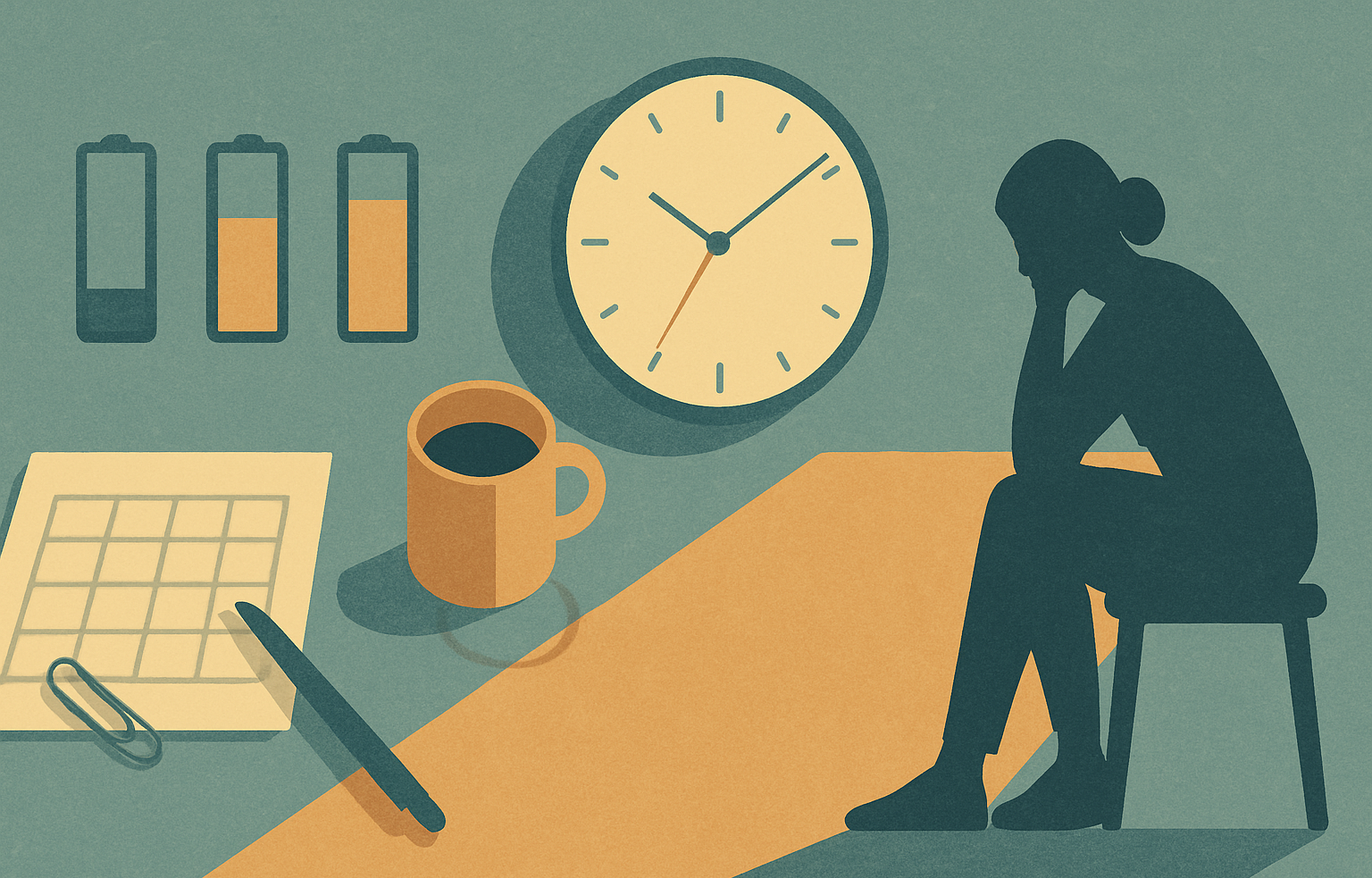
Your calendar looks perfect on paper. Morning for deep work, afternoon for meetings, a block for the gym, dinner with friends. Then the day starts, your brain feels like wet cardboard by 2 p.m., and that tidy plan quietly falls apart.
You do not have a scheduling problem. You have an energy problem. Time is fixed, but your energy moves in waves. If you manage only minutes and ignore those waves, you keep losing days that look organized but feel impossible.
Time Is a Container, Energy Is the Fuel
You wake up with the same twenty-four hours you always have. You do not wake up with the same fuel.
Some mornings you feel sharp and clear, other mornings you feel like you are walking through syrup. The clock looks identical, but the quality of those hours is completely different. Treating a low-fuel hour as equal to a full-tank hour is where a lot of productivity advice quietly fails.
Think of your day like a series of batteries, not one long line of time:
- A mental battery for focus and problem solving
- An emotional battery for patience, empathy, and willpower
- A physical battery for movement and basic stamina
You drain these in different ways. Three hours of complex writing might barely move your physical battery, but your mental battery can be almost empty. A tense conversation might leave your emotional battery flat even if you have barely moved from your chair.
If you only think in terms of time, you try to cram more tasks into the same calendar box and ignore how those tasks hit your different batteries. If you think in terms of energy, you start to ask a different question: what kind of fuel does this task need, and when do you actually have that fuel available?
That is why copying someone else’s routine often fails. You are trying to run your day on their battery pattern. You need to know your own.
Map Your Natural Peaks and Troughs
Before you can manage energy, you have to see it. Right now your day might feel like one blurred state. It is not. You already have patterns. You just have not named them yet.
For the next week, you can run a simple experiment.
Set three tiny check-ins.
Use your phone or calendar to ping you at three times: shortly after you start your workday, mid-afternoon, and early evening.Rate your batteries.
At each ping, jot down three numbers from 1 to 5:- Mental: How clear is your thinking?
- Emotional: How patient and steady do you feel?
- Physical: How energetic does your body feel?
Note what you are doing.
Add one short phrase: “email”, “coding”, “meeting”, “scrolling”, “walking”, “arguing”, “reading”. Keep it rough.
After a week, patterns start to show. Maybe your mental battery is a 4 in the first hours after waking, drops to a 2 right after lunch, then climbs to a 3 in the evening when things are quiet. Your emotional battery might dip right after a regular meeting. Your physical battery might spike after a short walk.
You are not trying to design a perfect schedule yet. You are trying to answer a simple question: when are you naturally good at what kinds of activities?
A small example: imagine you see that every day at 3 p.m., your mental rating is a 2, emotional is a 2, physical is a 4. You keep scheduling deep planning sessions at that time, then feel broken when you cannot think clearly. The plan is not failing because you are weak. It is failing because you keep asking the wrong battery to carry the load.
You can take this a step further. Once you see a clear low point, you can deliberately place something tiny and restoring there, like a 10-minute walk or a short stretch. You might notice that the ratings at your next check-in creep up without adding more hours, just because you spent that trough differently.
Match the Work to the Battery, Not the Clock
Once you see your daily waves, you can start to line tasks up with the right kind of energy instead of pushing everything through the same narrow hours.
You are still using blocks of time, but you design them from the inside out. You start with the energy a task needs, then ask where that energy actually shows up in your day.
1. Guard your highest-focus window
Cal Newport uses the phrase “deep work” for demanding tasks that need full attention. You likely have only one or two windows in a day where this is even possible.
If your check-ins show that your mental battery is usually highest between 9 and 11 a.m., that window becomes prime real estate. Treat it differently:
- No meetings if you can help it.
- No “quick” email checks at the top of the hour.
- One clear target task, not a pile.
You are not adding more work here. You are trading low-value tasks out of this window and moving them somewhere your brain is already shallow.
This often feels uncomfortable at first. You might be used to spending your freshest time warming up slowly with small tasks. It feels safe. Energy management asks you to do the opposite: spend your best energy where it buys you the most progress, even if it feels heavy.
If you are a designer, that might mean you open your design file at 9 a.m. instead of clearing Slack. If you are a student, that might mean tackling your hardest problem set before you look at any group chats. The work is the same. The fuel behind it is not.
2. Use low-energy time for low-stakes tasks
You will have stretches where your mental battery is low but you still have time in the day. Mid-afternoon is a common trough. Instead of fighting that dip with caffeine and self-judgment, put the right kind of work there.
These blocks are perfect for:
- Routine admin
- Simple replies
- Tidying up notes and files
- Light reading that does not demand analysis
When you align tasks like this, you no longer need to “power through” every dip. You are still productive, but at a level that fits the fuel you actually have.
You can even plan a micro-routine around this. For example, you might reserve 3 p.m. to 3:30 p.m. as your “maintenance half hour”: inbox, calendar, receipts, loose ends. You do not expect big thinking here. You are just sweeping the floor of your day.
3. Respect emotional and physical dips
You rarely think in terms of emotional or physical batteries when you plan your day, yet leaks here quietly wreck your plans.
If your emotional battery drops after a certain recurring meeting, do not put your most delicate creative work right after it. Give yourself a buffer with mechanical tasks or a short walk. If your physical battery crashes late at night, do not keep promising yourself that you will start that new workout at 10 p.m. You will not.
Matching work to energy is simple in principle: heavy work in high-energy windows, lighter work in low-energy ones. The discipline is in accepting what your actual waves look like, not what you wish they were.
Train Your Daily Battery, Do Not Just Spend It
There is a point that often gets lost in productivity talk: energy is not only something you conserve. It is something you can train.
You already know this intuitively with your body. If you start walking a bit every day, your capacity grows. The same applies to your ability to focus and to regulate your emotions, just with different inputs.
Here is the part that feels contrarian: the habits that grow your energy rarely look “efficient” in the moment. They look like you are doing less. You are pulling back from constant output so your system can recharge and adapt.
A few levers that reliably change your usable energy:
Sleep as an input, not a leftover.
If you cut sleep to “gain” time, you are quietly trading high-quality hours for dull ones. Matthew Walker goes deep into how sleep underpins learning, memory, and mood. In daily terms, this means that one rested hour can replace several exhausted ones. Protecting sleep is not a luxury. It is a productivity strategy.Micro-rest instead of constant grind.
You might assume that a break is something you earn after finishing work. Flipped around, a short, regular break is what lets your brain sustain heavy work. Five minutes of looking out a window or stretching every hour can keep your mental battery from hitting zero.Rituals that signal mode changes.
Your brain likes cues. A pre-work ritual, even something tiny like brewing a specific tea and closing all chat apps, can train your mind to bring more energy into that block. A shutdown ritual at the end of the day can help your emotional battery stop leaking into the evening.Boundaries as energy fences.
You might think of boundaries as something you set to protect time. They also protect energy. Saying no to a project that exhausts you might not free many hours in your calendar, but it can free a huge portion of your emotional battery.
You do not have to overhaul your life. You are shaping your capacity the same way you shape a muscle: small, repeated stresses that you recover from, not one heroic weekend of effort.
You might even pick one battery to train first. If your mental battery is your bottleneck, focus on sleep and protected deep-work windows. If your emotional battery keeps draining, focus on boundaries and small mood-reset rituals between tasks. Training one battery usually helps the others.
When Common Advice Backfires on Your Energy
You hear a lot of standard phrases around productivity. Some sound reasonable, but they quietly clash with energy management.
Consider a few and how they can trip you up.
”Just wake up earlier”
This advice ignores what you are waking up with. If you cut sleep to gain an extra hour at 5 a.m., you might win some quiet time, but you might also chop your mental capacity for the entire day. That first hour looks impressive on social media, yet your 10 a.m. to 4 p.m. window quietly collapses into fog.
A better question is: when do you wake up feeling most restored, and how can you protect that sleep? The clock time is secondary to the quality of the energy you bring into the day.
”Hustle harder”
There is a ceiling to raw effort. Past a certain point, more hours with a drained battery do not produce more value. You have seen this when you stay up late forcing work and then spend half the next day fixing what you wrote.
You are not lazy if you cannot grind all day. You are biological. Your energy cycles are a feature, not a bug. Working with them often looks slower from the outside, yet it lets you sustain progress over months instead of collapsing every few weeks.
”Batch everything”
Batching similar tasks can help you reduce context switching, as Stephen Covey urged when you focus on what is important, not just urgent. Yet pure batching without regard to energy can backfire. A four-hour block of back-to-back emotionally heavy conversations might fit neatly into your calendar, but your emotional battery might be wrecked for the rest of the day.
You can still batch, but use your energy map as a constraint. Ask: How long can I realistically stay in this mode before the quality drops below what I am willing to accept? Then design your blocks around that limit, not around an abstract ideal.
The thread running through all of this is simple: any advice that treats you like a machine that can output at a constant rate will eventually collide with your biology. Energy management is you refusing to pretend that you are a robot.
One Small Step Today
Pick tomorrow’s single highest-focus task, then place it in your strongest mental-energy window and protect that block with one concrete boundary, such as turning your phone to Do Not Disturb or closing your email for that period.