Morning Routines That Actually Work
Most morning routines try to squeeze more tasks into your first hour. You need something simpler: a stable starting state you can actually repeat.
You have probably tried at least one ambitious morning routine. A long list of habits, a strict wake-up time, and maybe a cold shower that lasted a week. Then real life showed up, and the whole thing collapsed.
The problem is not that you lack discipline. The problem is that most morning routines optimize the wrong thing. You do not need a turbocharged power hour. You need a stable, repeatable starting state.
The Real Job of a Morning Routine
You are often told that your morning should be a productivity machine. Meditate, journal, plan, exercise, read, eat perfectly, and be at your desk by 7:00. On paper it looks impressive. In practice it is fragile.
A routine that actually works does one quiet job: it moves you from sleep into a stable baseline where you feel steady, awake, and able to choose your next move on purpose.
A stable starting state usually has three qualities:
- Predictable energy. You may not feel amazing, but you know how you will feel. No violent swings between groggy and wired.
- Low mental noise. Your head is not already buzzing with regrets about yesterday or dread about today.
- One clear next step. You know what comes after the routine without another round of decision-making.
Imagine two different mornings.
On Monday, you wake up, grab your phone, scroll messages, answer one email, then notice the time and rush. You skip breakfast, mentally replay a tense conversation from yesterday, and tell yourself you will get organized once you reach your desk. You start the day already behind and scattered.
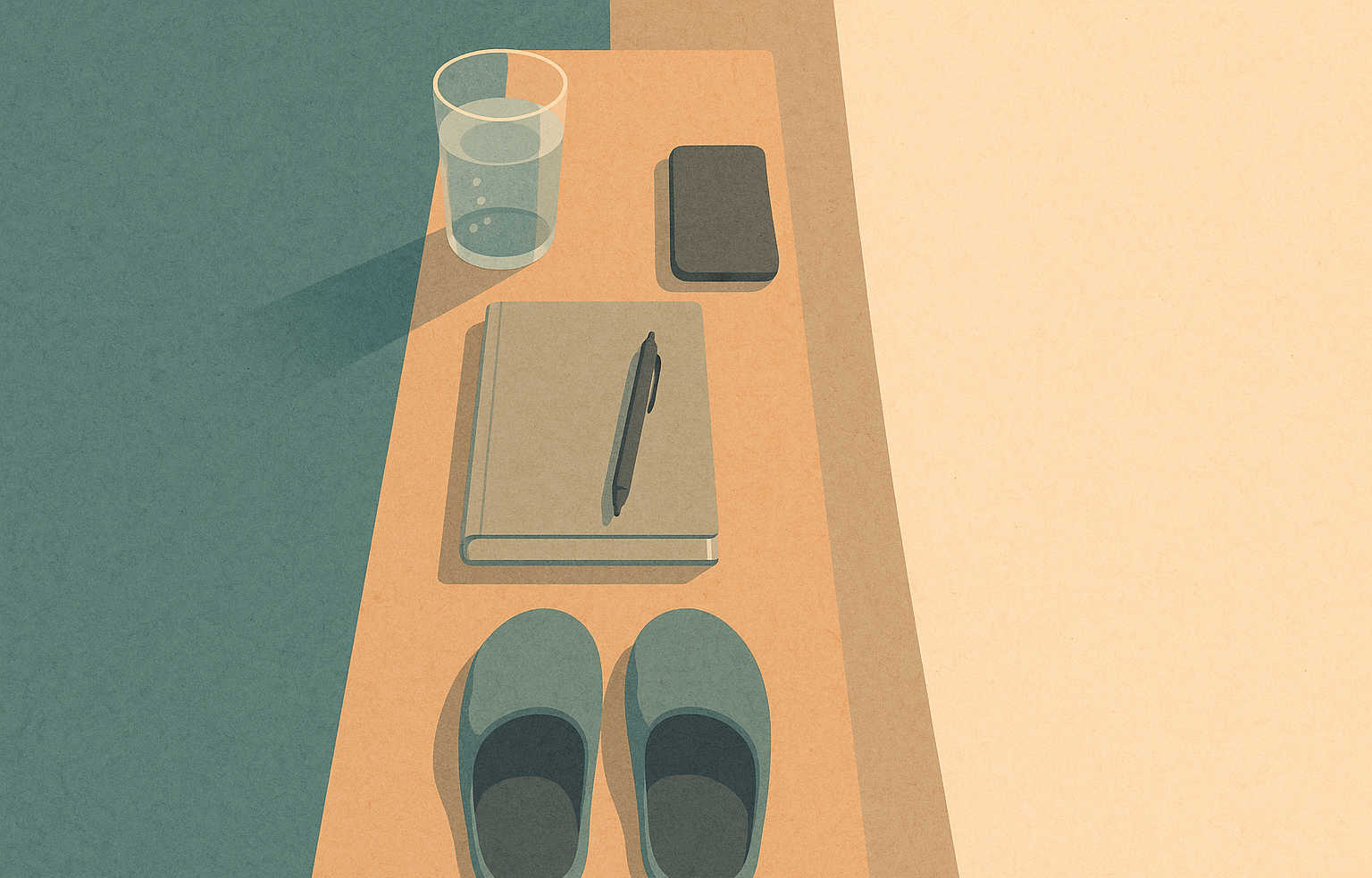
On Thursday, you wake up, avoid your phone, drink a glass of water, move your body for five minutes, sit for three minutes to notice your breath, then look at one written priority for the day. Nothing fancy. You still have a full schedule, but you feel just steady enough to handle it on purpose.
The second morning is not more productive because it contains more actions. It works because it gives you a consistent floor. From there, you can add focus, work, or even rest. The routine sets your state, not your output.
Why Your Previous Routines Fell Apart
When a routine fails, you often blame willpower. You tell yourself you need to try harder, wake up earlier, or care more. The real issue usually sits elsewhere.
You designed for the best day, not the average day
You build a plan that fits a calm week with no late meetings, no sick kids, and eight hours of sleep. That week happens rarely. As soon as life shifts, your routine does not fit, so you drop it.
A routine that lasts is built for your messy, average day. If it survives a night of poor sleep and a surprise obligation, it will survive most things.
You overloaded the front of the day
You treat your morning like a suitcase and try to stuff every self-improvement habit into it. Reading, journaling, language learning, mobility work, long runs, elaborate breakfasts. On day three, you oversleep by twenty minutes, and suddenly the list is impossible.
You then face an ugly choice: either drop half of it and feel like you failed, or skip the routine entirely. Most of the time, you skip it.
You chased intensity instead of identity
You might say, “I will run 5 kilometers every morning,” when you are not yet someone who moves daily. The gap is too large. You are trying to leap straight into a new lifestyle.
James Clear talks about identity-based habits. If you want to build a durable practice, you focus on becoming “someone who moves every morning,” not “someone who runs far every morning.” The distance can grow later. The identity needs a gentle on-ramp.
You ignored your natural rhythms
Maybe you are trying to journal and do deep thinking as soon as you open your eyes, even though your brain is foggy until coffee. Or you are forcing intense workouts at 5:30 even though your body loosens up closer to lunch.
A routine that respects your real rhythms feels easier and more humane. It uses the morning for what your body and mind are actually good at then, not what a book said you should be doing.
Design a Stable Starting State, Not a Power Hour
Instead of asking what the perfect set of morning habits is, ask something narrower: “What is the smallest routine that reliably moves me into a stable starting state?”
Think of your routine as a launch strip, not a showcase. It is short, consistent, and lined up with how your life actually works.
Here is a simple framework.
1. Decide how you want to feel, not what you want to do
Pick three words that describe your preferred baseline by, say, 8:00 a.m. Examples:
- Calm, awake, prepared
- Grounded, alert, uncluttered
- Warm, focused, steady
Now ask: what tiny actions move you toward those feelings?
- If you want calm, you might need two minutes of quiet before screens.
- If you want awake, you might need light, water, and a little movement.
- If you want prepared, you might need a quick look at your top task.
This reverses the usual process. You are not copying someone else’s habit list. You are choosing your state first, then building backward.
2. Limit yourself to three moves
A routine bloats quickly if you do not cap it. For a stable start, pick at most three elements:
One thing for your body
Simple options: stretch for two minutes, walk around your home, a few squats, or a short mobility pattern.One thing for your mind
Examples: a three-minute breathing practice, one page of a paper journal, a short “brain dump” of worries.One thing for your day
Examples: review one written priority, glance at your calendar, or write a single sentence about what would make today feel well spent.
You can usually complete this in 10 to 15 minutes. The short duration makes it possible on tired days and busy days, which are the exact days when you need stability most.
3. Anchor to something that already happens
You already have fixed points in your morning: your alarm, brushing your teeth, making coffee, letting a pet out, waking a child.
Attach your routine to one of these anchors. For example:
- After you put the kettle on, you stretch for two minutes.
- After you brush your teeth, you sit on the edge of the bed and breathe for three minutes.
- After you start your coffee, you open your notebook and write your one priority.
This echoes what BJ Fogg calls tiny habits. The anchor makes your routine harder to forget, and the tiny size makes it hard to resist.
The Quiet Power of Doing Less
You might feel uneasy about shrinking your routine. You worry that five minutes of movement and three minutes of reflection cannot matter.
Here is the counterintuitive part: doing less can give you more.
Consistency beats variety
If you change your routine every week, your brain never gets to treat it as automatic. You have to decide and remember each piece, which costs energy.
A small, repetitive routine becomes like tying your shoes. You do it without drama. The benefit is not in any single morning, but in the cumulative effect of starting hundreds of days more steadily.
Compare two approaches.
- You perform a dramatic 60-minute routine twice a week.
- You perform a quiet 10-minute routine five days a week.
After a month, you have had many more stable starts with the shorter routine. Your days feel calmer, even though nothing about your life looks extreme from the outside.
Stability protects you when life gets messy
A fragile routine disappears right when you are under stress: during deadlines, travel, illness, or family issues. Those are the weeks when you most need a reliable baseline.
If your routine is so light that you can do it in a hotel room, at a relative’s house, or after a poor night of sleep, you keep a piece of sameness when everything else feels uncertain. That sense of “I still did my morning” can anchor you more than a perfect workout would.
Your routine is not a performance
A subtle trap is treating your morning like proof that you are serious and disciplined. You stack habits partly for the story you can tell yourself.
That pressure makes you more likely to quit. The moment you break the streak, you feel like the story is ruined.
Drop the performance. Your morning routine is private infrastructure, not a show. If it quietly sets your state, it is doing its job, even if nobody would be impressed reading it on a list.
Adjust Your Routine Like a Scientist, Not a Judge
Your life changes. Seasons shift, work hours move, children grow, health fluctuates. A rigid routine that cannot adapt will eventually snap.
Instead of treating each change as a failure, treat your routine like a living experiment.
Run two-week experiments
Pick a version of your routine and commit to it for two weeks. During that time:
- Keep the structure the same. Do not tinker daily.
- Notice how you feel by mid-morning.
- Notice how much friction you feel when starting.
At the end of two weeks, ask:
- Did this move me into the state I wanted?
- What part felt heavier than it needs to?
- What is the smallest adjustment that might help?
Then change one variable. Maybe you swap journaling for a walk. Maybe you move the routine 15 minutes later or earlier. Maybe you trim something that feels like clutter.
Watch for three red flags
Treat these as signals that your routine needs adjustment, not proof that you are failing.
- Frequent skipping on busy days. Your design is too heavy. Shrink it until it survives your worst weekday.
- Resentment toward a specific habit. That piece might belong later in the day, or not at all. A routine that you quietly hate will not last.
- No clear link to your desired state. If you want “calm, awake, prepared,” yet your routine leaves you rushed and wired, you are serving the wrong goal.
Approach this like tuning a recipe. Small changes, tested over time, until it tastes right.
One Small Step Tomorrow Morning
Tomorrow morning, before you sleep tonight, choose one anchor and one action, and write them on a scrap of paper:
“After I [trigger], I will [tiny action].”
Examples:
- After I start the coffee machine, I will stand at the counter and take ten slow breaths.
- After I brush my teeth, I will write one sentence about what matters most today.
Put that paper where you will see it when you wake up, such as by your phone or toothbrush. Tomorrow, do that single action. That is your first stable starting point. Everything else can grow from there.