Flow: The Psychology of Optimal Experience
Flow argues that optimal experience arises when challenge and skill meet at the edge of our abilities, creating an autotelic, immersive state where time falls away.
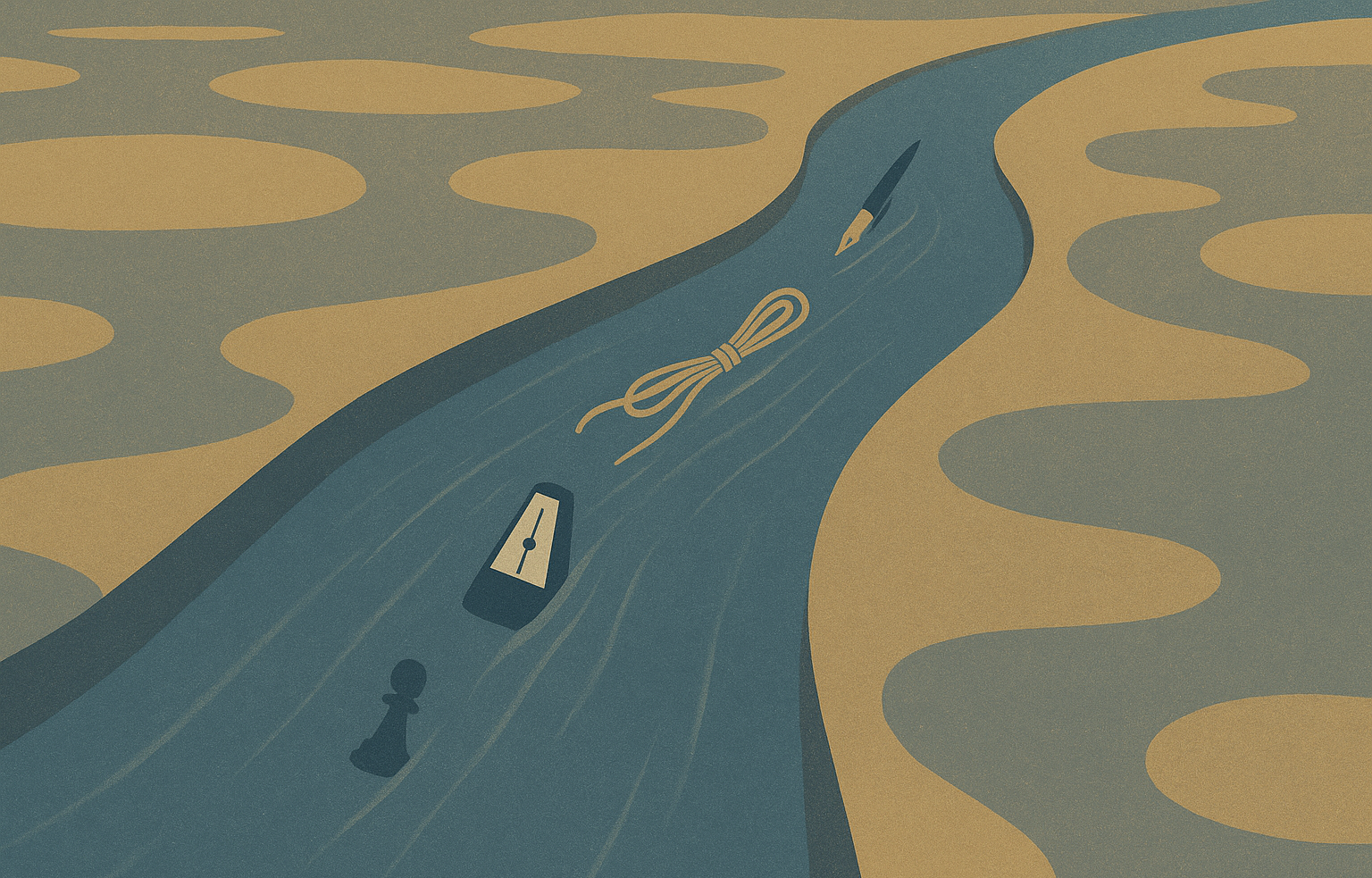
Optimal experience occurs when challenge meets skill at the edge of capability, producing a deeply absorbing, self-justifying state where attention narrows and time warps.
Who this book is for / who it is not for
Flow is for readers who care less about hacks and more about understanding what a good life feels like from the inside. If you are drawn to ideas like deep work, meaningful goals, and intrinsic motivation, this is source material. Mihaly Csikszentmihalyi spent decades interviewing artists, climbers, chess players, and surgeons to map what they all recognized as their best moments.
It will appeal to people willing to sit with theory, data, and a few dry survey tables in order to gain language for experiences they have glimpsed but never named. If you like linking values, attention, and fulfillment, pairing this book with something like The Art of Mindfulness: Cultivating a Present and Peaceful Life works well.
This is not for readers looking for quick productivity tricks or a motivational pep talk. If you are impatient with psychology research, allergic to graphs, or want step-by-step career advice, the book will feel slow and abstract. Nor is it ideal if you are currently in acute crisis; it presumes a stable enough life to experiment with shaping your attention.
The anatomy of flow: clear goals, tight feedback, deep concentration
Csikszentmihalyi’s central contribution is a precise description of what flow actually consists of. Across interviews with rock climbers, dancers, chess masters, and factory workers who enjoyed their jobs, he found the same pattern of eight elements, especially three that matter most for daily practice:
- Clear goals for the activity
- Immediate feedback
- A balance between challenge and skill
In the book, a rock climber describes planning a route, placing each handhold with full concentration, and reading the rock’s response instantly. A composer talks about writing music and losing any sense of self, feeling as if the composition is unfolding by itself. An assembly-line worker in an otherwise dull job explains how he turned each shift into a self-imposed game of speed and precision, tracking his performance minute by minute.
These examples show that flow does not depend on the glamour of the activity but on how the activity is structured in your awareness. When your goal is clear, you see at once whether you are moving toward it, and the task pushes you just hard enough to demand full attention, attention narrows, self-consciousness fades, and the activity becomes absorbing for its own sake.
For self-development, this is liberating. It suggests you can redesign parts of your existing life to create more flow instead of waiting for the perfect job or hobby. Tighten goals, shorten feedback loops, and calibrate difficulty. A routine email slog will not transform into a mountaineering expedition, but it can become a focused session if you define a specific outcome, timebox it, and remove distractions.
The challenge–skill balance and the map of experience
The most memorable visual in the book is Csikszentmihalyi’s simple diagram of how our perceived challenge and perceived skills interact. When challenge is high and skills feel low, we experience anxiety. When skills exceed challenge, we drift into boredom or apathy. Flow lives in the narrow channel where high challenge meets high skill.
He illustrates this with a story of a young worker in a factory who initially finds his job tedious. Over time, the worker begins setting small challenges, timing himself, trying to improve his speed and accuracy. As his skills grow, he keeps raising the bar. What could have been a life of chronic boredom becomes an arena where he experiences genuine engagement. The task did not change; the level of challenge did.
This map is powerful because it turns your moods into something you can act on. Feeling anxious about a project? You might need to build your skills through practice or break the project into smaller challenges. Feeling bored and restless? You may have outgrown the task and need to increase difficulty, take on more responsibility, or redefine your goal.
Seen through this lens, a large part of modern dissatisfaction comes from spending long stretches in the apathy and boredom zones while occasionally spiking into anxiety. Flow is the narrow path where you are stretching but not breaking. That idea connects well with the site’s theme of Deep Work as a Daily Practice: protecting blocks of time in that channel is how deep work becomes emotionally sustainable rather than a willpower contest.
Autotelic experiences and the autotelic personality
Flow activities are described as autotelic: they are worth doing simply because of the experience they create, independent of external rewards. Csikszentmihalyi contrasts this with activities done primarily for money, status, or obligation. The climber interviews, for instance, highlight people who return to harsh, risky environments not for trophies or fitness benefits but for the felt sense of total absorption and unity with what they are doing.
Across thousands of interviews, he notices that some people seem to find flow across many parts of life. They can turn housework into a game, find satisfaction in routine jobs, and treat setbacks as challenges to engage with. He calls this pattern the autotelic personality: a tendency to order one’s consciousness around activities that are intrinsically rewarding.
The book explores how such a personality may grow from childhood environments where curiosity is encouraged, feedback is given without humiliation, and effort is valued over outcome. A key example is a group of teenagers who spend their free time playing musical instruments or tinkering instead of only consuming entertainment; they report more frequent flow and greater life satisfaction.
For readers, the takeaway is not that you either have an autotelic personality or you do not. Csikszentmihalyi suggests you can cultivate it by routinely asking: “How could I turn this into a game? What goal would make this engaging by itself? How do I need to focus my attention so that the doing is the reward?” Over time, that habit of framing might matter as much as changing external circumstances.
Ordering consciousness: attention, meaning, and a life well lived
Beneath the talk of optimal experience lies a more ambitious claim: the quality of our lives is determined by how we direct our attention. Consciousness is presented as a limited channel. At any moment, you can attend to a problem, a fear, a memory, or the task in front of you, and that choice shapes your subjective reality.
Csikszentmihalyi shares accounts from people who endured extreme adversity, including a political prisoner who survived years in solitary confinement by creating mental games and learning foreign languages in his head. Deprived of external freedom, he structured his inner world to maintain flow. By contrast, many people with comfortable lives drift through days of fragmented attention and low engagement.
This is where Flow connects with questions of values and purpose. If you spend more time in flow while doing activities aligned with your core values, you get a double benefit: your moment-to-moment experience improves, and you are moving toward a life that feels coherent. Pairing the book with reflection on your values, such as in Understanding Core Values, helps ensure you do not become highly skilled and focused at climbing a ladder that matters little to you.
The book closes by suggesting that meaning is not something you discover but something you construct by ordering your experiences around chosen goals: a craft to master, a cause to serve, a family to nurture. Flow is then both a psychological state and a compass. Where you most reliably find it may be pointing toward the life you should be building.
Where the thesis overreaches
Flow has aged well in broad strokes, yet it has limits. Csikszentmihalyi sometimes writes as if flow were the main ingredient of a good life, underplaying structural realities like poverty, illness, or discrimination that constrain people’s options. Telling a burned-out single parent working two jobs to simply “restructure experience” can sound naive or even dismissive.
Some later research has also nuanced the picture. Intense absorption is not always beneficial. People can enter flow states while gambling, scrolling games, or engaging in work cultures that exploit their willingness to lose track of time. The book acknowledges that destructive activities can produce flow, but it does not offer much guidance on distinguishing healthy from harmful versions beyond a general appeal to long-term consequences.
Finally, the writing can be repetitive, with survey data that feel thin by today’s standards and heavy-handed generalizations about cultures. None of this invalidates the core idea, yet it should caution us against treating flow as a universal prescription or as the only metric that matters.
Where to start in the book
If you read selectively, start with the early chapters that define flow and describe its components, then move to the sections on work and leisure. The opening chapter that sketches “optimal experience” and the chapter where he introduces the challenge–skill balance are the heart of the argument. The later chapters on the self and meaning are worth reading once you are familiar with the basic model but can be skimmed on a first pass. If the prose resonates, a slow reread of the work and relationships chapters a few months later helps translate the ideas into concrete life experiments.
A life oriented around flow is not necessarily easier, but it is far more alive.
The best moments in our lives are not the passive, receptive, relaxing times. The best moments usually occur if a person’s body or mind is stretched to its limits in a voluntary effort to accomplish something difficult and worthwhile. — Mihaly Csikszentmihalyi