The Power of Solitude
You spend most days surrounded by noise, yet feel strangely disconnected from yourself. Solitude is the quiet space that lets your mind come back into focus.
You scroll, reply, react, and respond, yet feel oddly untouched by any of it. Your mind is busy, but your thoughts are thin. When you finally get a quiet moment, you reach for your phone without thinking.
Solitude is the missing space between all that noise. It is not loneliness, and it is not an escape from life. It is a deliberate pause that lets you actually meet your own mind again.
Solitude Is Not Loneliness
Loneliness is the sting of being disconnected when you want connection. Solitude is the choice to step aside for a moment, even when company is available, so you can be with yourself on purpose.
Picture two evenings.
On the first, you sit alone at your kitchen table. The house is quiet, but your chest feels heavy. You refresh your messages, hoping someone will reach out. The silence feels like a verdict. That is loneliness.
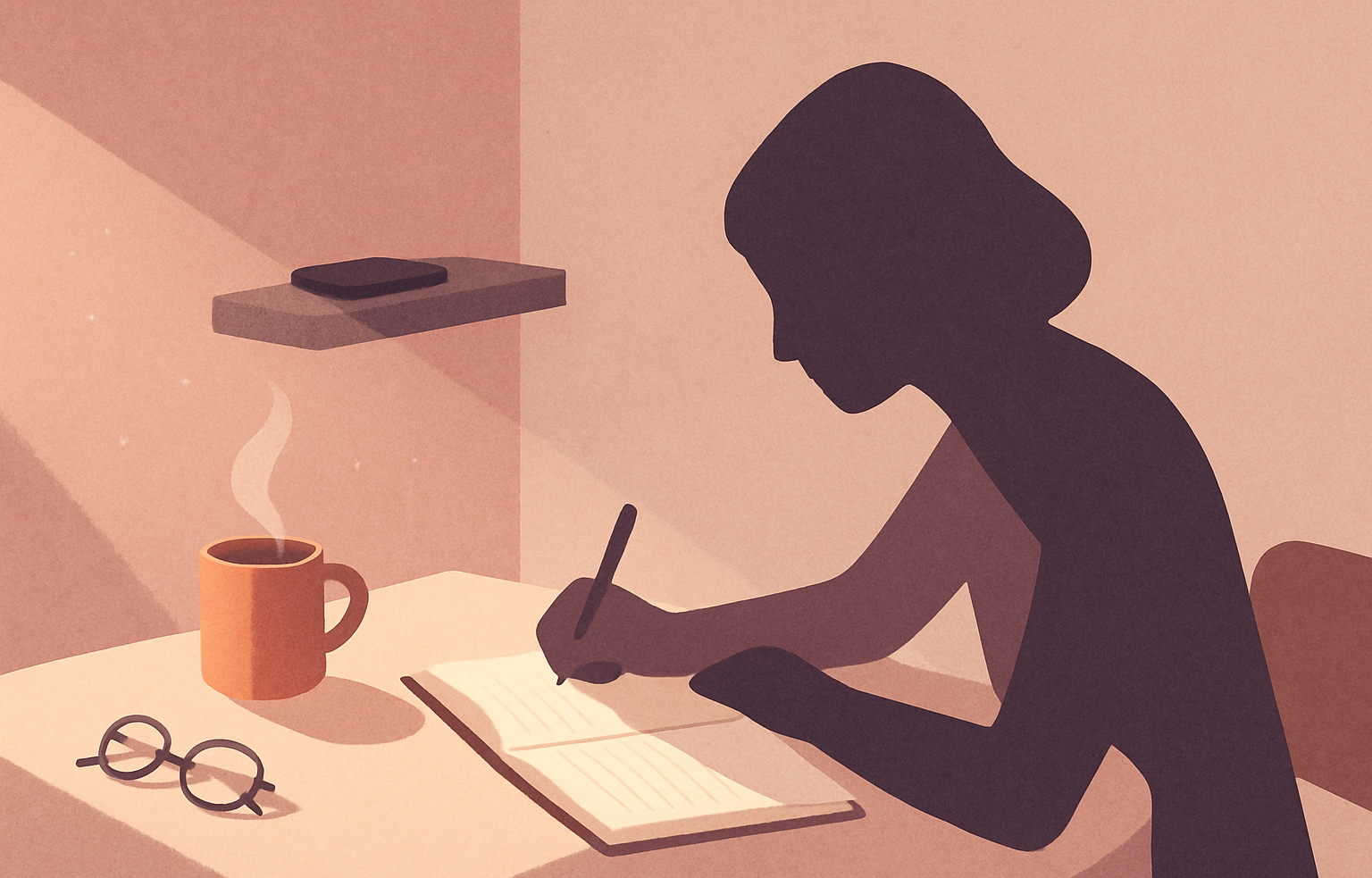
On the second, you close your laptop at the end of the day. You put your phone in another room and sit at the same table, this time with a notebook and a cup of tea. You are still alone, but you chose this. You are not waiting to be rescued from the quiet. You are using it. That is solitude.
The outer situation looks similar. The inner posture is different:
- Loneliness feels like being pushed out.
- Solitude feels like stepping aside.
You might even feel lonely in a crowded room if you are unseen or performing the whole time. You can feel deeply connected during solitude when you are honest with yourself.
A useful question is: Did I choose this, and am I free to leave it? If the answer is yes, you are likely in solitude, not abandonment.
You need that chosen space. Without it, your thoughts are always half-formed, shaped by replies, likes, and expectations that arrive faster than you can process them. Solitude slows the stream enough for real thinking to form.
What Constant Noise Does to Your Mind
You probably think of noise as sound: conversations, notifications, traffic. The more dangerous noise is cognitive. Every new input demands a tiny reaction. A headline, a message, a photo, a comment. Your attention jumps, flickers, jumps again.
Across a day, that adds up to a specific pattern: lots of opinions, very few conclusions. You hear yourself say things like:
- “I have been thinking about changing jobs,” but you never get far enough to outline what you actually want.
- “I know I should sleep more,” but you do not sit long enough with the consequences to feel why it matters.
- “I am tired,” but you do not know whether you are physically exhausted, mentally overloaded, or emotionally drained.
Your thinking gets crowded out by reacting. Even your rest becomes noise. A show plays while you scroll. A podcast runs while you cook and answer texts. You are never quite doing one thing, which means you are never fully with your own thoughts.
Jon Kabat-Zinn often describes mindfulness as paying attention on purpose. Solitude is the environment that makes that kind of attention possible. When you strip away new inputs for a while, your mind does something interesting: it starts replaying, sorting, and connecting what is already there.
You notice that one conversation that still bothers you. You remember a task you keep avoiding. You remember an old idea that still feels alive. This is not distraction. This is your mind doing delayed maintenance that was pushed aside during the day.
The contrarian part is this: you do not always need better focus techniques. You sometimes just need less input. Productivity tricks are like organizing an overstuffed closet. Solitude is the moment you stop buying new things and actually look at what is already on the shelf.
You might resist this because noise feels easier than thinking. Checking one more thing gives you a quick sense of doing something. Sitting quietly shows you the backlog you have not faced. That discomfort is exactly why solitude works. It puts you back in contact with what is real instead of what is merely urgent.
How Solitude Restores Your Ability to Think
You think more clearly in solitude for a few simple reasons.
First, there is no audience. When you are around others, even online, part of your brain is tracking how you appear. You edit, soften, sharpen, or exaggerate thoughts to fit. In solitude, you can drop that performance. You can admit things you would never say out loud, which is often where the real truth starts.
Second, your attention can rest on one thing long enough for it to deepen. Focus is not just about excluding noise. It is about staying with one thread of thought past the first obvious idea, through the boring middle, into the part where something new emerges.
Imagine you are trying to decide whether to switch paths in your career. While you sit in a group chat or scroll through advice threads, every opinion lands: “Follow your passion,” “Think of the salary,” “Do not waste the years you already put in.” It all blurs together. When you spend a quiet Saturday morning walking alone without headphones, something shifts. Memories and feelings that did not fit the group conversation show up. A specific project that lit you up. A comment from a manager that still stings. A value that matters more than status. The decision is still hard, but it is no longer shallow.
Third, solitude sharpens your inner voice. At first, that voice might be critical or scattered. You might replay old embarrassments or future worries. If you stay, something else appears underneath: a steadier sense of what feels right or wrong for you, not for everyone.
You can think of this as cognitive uncluttering. Your mind is full of other people’s stories about what success, rest, and a “good life” should look like. In solitude, you notice which stories feel false in your body. You cannot do that kind of sorting while you are still inside the crowd.
A small practice helps here: when you are alone, pick one question and stay with it longer than feels comfortable. For example, “What do I actually want my mornings to feel like?” Write whatever comes up for ten minutes. At first you will list obvious answers. If you keep going, you will uncover details that surprise you, like “I want ten minutes without anyone needing anything from me,” or “I miss reading before work.” That specificity is the beginning of real change.
The Emotional Work Solitude Makes Possible
Solitude is often recommended for focus, planning, or creativity. The quieter benefit is emotional. You cannot process what you refuse to feel, and you usually refuse to feel things when you are rushing, chatting, or numbing.
Think about a season when you keep saying yes to everything. You take extra shifts, answer messages late into the night, keep every weekend packed. From the outside, you look driven. Inside, you feel hollow, irritated, and strangely fragile. Free evenings make you anxious, so you add more plans.
If you dare to spend one evening alone, no screens, you might finally notice what all that busyness is hiding: grief that comes up in the silence, resentment about a lopsided relationship, fear that surfaces when there is nothing to distract you. That can be uncomfortable. This is one reason you might avoid solitude without realizing it. The first wave of feeling can be rough.
This is where self-compassion matters. Kristin Neff describes self-compassion as treating yourself like you would treat a friend in pain. Solitude without that attitude can feel like sitting in a room with your harshest critic. Solitude with self-compassion turns into a private space where you can actually admit, “That hurt,” or “I am scared,” without having to perform being fine.
You can use solitude to:
- Name emotions more precisely than “stressed” or “tired”.
- Notice recurring patterns in your reactions.
- Grieve losses you rushed past.
- Acknowledge desires you have been dismissing.
You might think you need another conversation to resolve an inner knot. Sometimes you need a conversation with yourself first, so the next talk with someone else is honest instead of reactive.
The contrarian point here is that solitude is not always calming in the moment. At first, it can feel like turning on a light in a messy room. Things look worse before they get better. You grow when you stay anyway.
Making Peace With Being Alone
You may like the idea of solitude in theory, yet feel restless or guilty when you try it. Two quiet obstacles often show up.
The restlessness
When you first sit alone without stimulation, your body might almost itch for distraction. You reach for your phone out of habit. You think, “This is a waste of time,” or “I should be doing something productive.”
Restlessness is not proof that solitude is wrong for you. It is proof that your nervous system is used to constant input. You are feeling withdrawal, not a warning. If you stay with it for a few minutes, the urge usually softens. You might notice your breathing slow, or your shoulders dropping.
A simple trick is to give your hands something gentle to do. You can hold a warm mug, stretch, or walk slowly. The point is not to be perfectly still. The point is to let your mind stop chasing the next ping.
The guilt
You might also feel selfish for stepping away. There is always another message you could answer, another task you could finish, another person you could help. Taking solitude can feel like taking something from them.
The quiet truth is that you are already paying a cost when you skip solitude. You are more irritable, more scattered, less present. People get a version of you that is half there. A small amount of deliberate solitude can make your time with others kinder and more focused.
You are not withdrawing from life. You are stepping back just enough to see it clearly. That distance lets you notice when you are living by old assumptions that no longer fit. It lets you choose responses instead of running on reflex.
Designing Solitude That Actually Works
Solitude is not just being physically alone. It is a specific container: time, space, and intention. If any of those are missing, your “alone time” turns into scrolling time or background-anxiety time.
You can design solitude by answering three questions.
1. When will you step away?
You need a defined start and end.
- Start and end time. For example, “Saturday from 9:00 to 10:00” or “Weekdays, first 20 minutes after waking.”
- Frequency. Daily short solitude can keep your mind tidy. Weekly longer solitude lets you do deeper thinking.
Consistency matters more than length. Fifteen minutes every morning will change you more than one long retreat you never repeat. You can also link solitude to an existing habit, like “after I wash the dinner dishes, I sit with a notebook for ten minutes.”
2. Where will you be?
Your environment quietly tells your brain what to do.
- Your desk might cue “work” and pull you into email.
- Your bed might cue “sleep” and make you doze off.
- A park bench, a quiet cafe, or a chair by a window can become a solitude spot if you use it consistently.
The key is low input. No TV in the background, no endless notifications. You do not have to sit still. Walking alone without headphones is one of the simplest forms of solitude. The movement keeps your body occupied while your mind unwinds.
If home is loud, you can get creative. You might sit in your parked car for ten minutes before going inside, or take the long way home on foot. The form matters less than the fact that, for a short window, nothing new is coming in.
3. What is this solitude for?
You do not have to rigidly script it, but a light intention helps.
You might decide:
- “This half hour is for emptying my head onto paper.”
- “This walk is for feeling whatever comes up without fixing it.”
- “This hour is for thinking through one decision only.”
Without intention, it is easy to slide into planning your grocery list or replaying a petty argument for the tenth time. With intention, you can gently guide your attention back when it wanders.
One more contrarian note: you do not need your solitude to be productive in a visible way. You might not produce plans, pages of writing, or breakthroughs. The main product is a clearer, less crowded mind. That benefit often shows up later, when ordinary moments feel less overwhelming.
One Small Step Today
Choose one short solitude window for tomorrow: ten minutes alone, no phone, with a pen and a piece of paper, and use it only to answer one question in writing: “What has been weighing on my mind lately?” Stop when the ten minutes end, fold the paper, and put it away.