The Eisenhower Matrix in Plain English
Your to‑do list is loud, but not all tasks deserve the same kind of attention. Use a simple four‑box map to calm the noise and choose what actually matters.
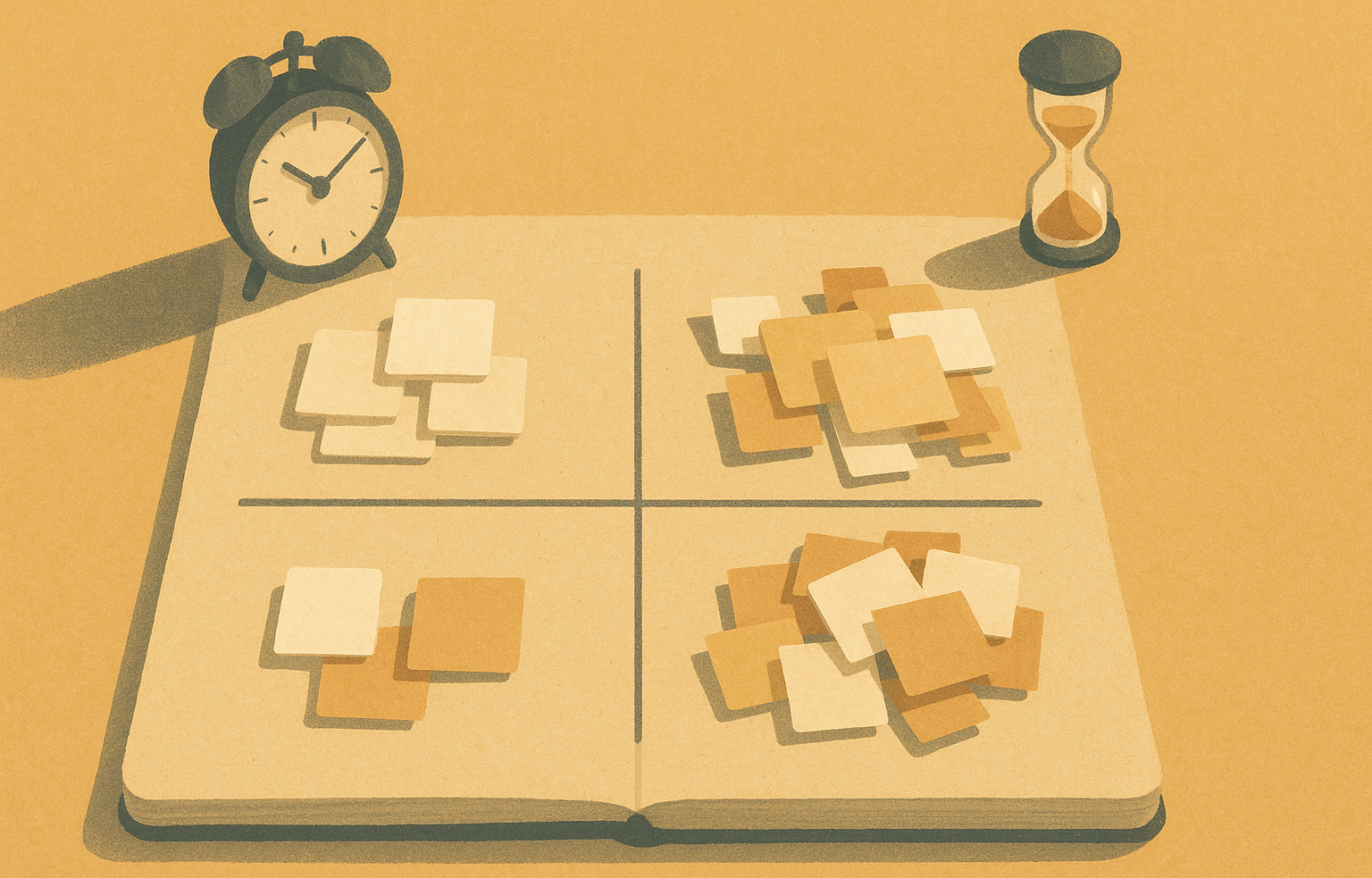
You open your to-do app and feel your chest tighten. There are errands, messages, half-finished projects, random ideas, all shouting at the same volume. You know they do not all matter equally, but in the moment they all feel urgent.
Urgent and important are not the same thing. The Eisenhower Matrix is a four-box tool that helps you see the difference so your list stops running your day.
Why Urgent Feels Bigger Than It Is
Your brain is wired to jump at anything that looks like a fire. A buzzing phone, a new email, a Slack ping, someone saying, “Got a minute?” Each one promises quick relief if you just handle it now.
The problem is simple: your long-term life does not shout. It whispers. Finishing the report that might change your career, booking the health check you have delayed, starting the skills course you say you want, none of these flash red.
So you get pulled toward:
- Tasks with a deadline, even if the outcome is trivial.
- Requests that sound polite but are not actually required.
- Easy items you can tick off quickly, just to feel productive.
You end the day exhausted, but the real work that actually moves you forward is still sitting there.
Stephen Covey used the idea of urgent versus important to explain this gap. Urgent is about time pressure. Important is about impact. You need both words in your head when you look at any task.
The Eisenhower Matrix simply gives you a picture for that distinction so you can stop relying on stress and guilt to choose.
The Four Boxes, In Real Language
The matrix is a 2 by 2 grid. One side is urgent or not urgent. The other side is important or not important. That gives you four boxes.
Forget the jargon. Think of them in plain English.
Box 1: Urgent and important
These are real fires. Consequences are serious, and the clock is ticking.- Finishing client work due this afternoon.
- Taking your child to urgent care.
- Fixing a production bug that is blocking customers.
- Paying a bill before a hard cutoff that would trigger fees or service loss.
You handle these first. No debate.
Box 2: Not urgent but important
These are quiet builders. They shape your future, health, relationships, and deep work, but nobody chases you about them.- Regular exercise and sleep.
- Deep project work due next month.
- Learning a skill that could double your options.
- A hard conversation that would clear long-standing tension.
- Planning your next quarter instead of drifting into it.
This is the box that changes your life. It never screams, so you have to protect it.
Box 3: Urgent but not important
These tasks feel pressing, but the impact on your real goals is small.- Most email.
- Many meetings.
- “Can you quickly look at this?” messages.
- Admin work that looks official but could be batched or handed off.
These are usually about other people’s timelines. Your job is not to ignore them, but to shrink your time here.
Box 4: Not urgent and not important
Time fillers. You do them by habit, boredom, or avoidance.- Scrolling social media with no end in mind.
- Clicking through news links for half an hour.
- Rearranging apps on your phone instead of starting the task in front of you.
- Refreshing dashboards and stats that do not change your actions.
You do not need to delete all of this from your life. You just need to see it for what it is: optional.
One contrarian point: Box 4 is not pure evil. A show you genuinely enjoy, a video game with friends, a walk that is more about wandering than performance, these can be honest rest. The problem is not any single moment of low-stakes time. The problem is when you live in this box without meaning to.
Mapping Your Actual Day Onto the Matrix
Reading about the matrix is easy. The shift comes when you apply it to your messy, real list.
Try this simple process.
1. Dump everything, no editing
Take a blank page and write down every task that is circling your head:
- “Reply to Mia about Friday”
- “Finish slide deck”
- “Book dentist”
- “Start portfolio site”
- “Buy groceries”
- “Scroll TikTok” (yes, be honest)
- “Price new laptop”
- “Text Dad back”
Do not organize yet. The point is to see what is actually there, not what you wish were there.
If you prefer digital, you can type this into a notes app, but the key is the same. You capture everything so your brain is not trying to juggle it in the background.
2. Ask two questions for each item
For every task, ask:
- If I never did this, what would actually happen?
- Will that outcome matter a week, a month, or a year from now?
Tasks that have real consequences for your work, health, money, or relationships are important. A missed deadline that affects your reputation, a doctor appointment, a call with someone you care about, a block of deep thinking on a key project, all land there.
Then add a third question:
- Is there a clear time pressure on this right now?
If someone is waiting, a system is blocked, or there is a true deadline close by, it is urgent. If not, it is not urgent, even if you feel guilty about delaying it.
You will mislabel some tasks at first. That is fine. You are training your sense of impact, not sitting an exam.
3. Place the tasks in the four boxes
Draw a quick 2 by 2 grid in your notebook. Label the axes: urgent vs not urgent, important vs not important. Then, without overthinking:
- Put real fires in Box 1.
- Put quiet builders in Box 2.
- Put other timelines in Box 3.
- Put time fillers in Box 4.
You will see patterns fast. For example:
- Your calendar is full of Box 3 meetings.
- Your evenings vanish in Box 4.
- Your biggest dream projects live in Box 2 and never get time.
Take one more step with this map. Circle the three Box 2 items that would change the feel of your week if you made real progress on them. This gives your next decisions a clear anchor.
For one week, just notice the boxes as you move through your day. You do not need to fix everything yet. Awareness already takes the edge off the anxiety, because now the pile has a shape.
What To Actually Do With Each Box
The matrix is not a poster for your wall. It is a set of decisions.
You can think of the four boxes as four verbs.
1. Box 1: Do
You handle urgent and important tasks as soon as you reasonably can.
Imagine a nurse finishing a medication round when a patient alarm goes off. That alarm is Box 1. It overrides almost everything, because the risk of ignoring it is real and immediate.
Your version might be less dramatic, but the logic is the same:
- Submit the report due in two hours.
- Call back the client who is locked out of a service.
- Deal with the leaking pipe before it ruins more of your home.
The trap here is living in this box all the time. If your whole day is Box 1, you are in constant firefighting mode, and Box 2 never happens. Long term, that guarantees more fires, not fewer.
Whenever you finish a Box 1 item, ask: “What could I schedule in Box 2 that would make this kind of crisis less likely next time?“
2. Box 2: Schedule
Box 2 tasks rarely happen by accident. You have to assign them time.
- Block non-negotiable hours for deep work.
- Put regular health, learning, and relationship time in your calendar.
- Treat these blocks as appointments, not suggestions.
Picture a freelance designer whose income swings wildly. When jobs are quiet, the designer scrolls, tweaks the portfolio, and worries. When a client rush comes in, the designer works late for weeks. Box 2 for this designer is simple: consistent outreach and skill growth when things are calm. A weekly two-hour block for contacting past clients, updating case studies, and learning one new tool would smooth the feast-and-famine cycle more than any new app.
This is where advice often gets too rigid. A perfectly packed calendar is fragile. Life will knock blocks around. The point is not to control every minute. The point is to make Box 2 visible and real, so it does not get squeezed out by every new email.
When a Box 2 block gets bumped, reschedule it like you would a missed medical appointment. You do not shrug and say, “I guess I will never see the doctor again.” You pick a new time.
3. Box 3: Limit or delegate
You cannot ignore Box 3, but you can shrink it.
Options include:
- Batch email and messages into two or three short windows.
- Say, “I can look at that tomorrow” instead of “right now.”
- Delegate or share tasks when possible: “Can you send me a short summary instead of a full meeting?”
Think of an office manager whose day gets eaten by “quick questions.” Every colleague walks in with “just a minute” requests that turn into ten. Without boundaries, the manager lives in Box 3 and never gets to process invoices or improve systems, which are Box 2.
To shift this, the manager might:
- Set two daily drop-in windows and keep the door closed outside them.
- Create a shared FAQ document and point people to it first.
- Ask, “Do you need this today, or is end of week okay?”
A useful question here is: “If I did this tomorrow instead of today, would anything meaningful break?” If the answer is no, it probably belongs lower on your list.
4. Box 4: Contain
You will still have Box 4. You are not a robot.
The goal is to move from compulsive to conscious.
You might:
- Put social media at a specific time, like 20 minutes after dinner.
- Keep your phone in another room during focused work.
- Decide how much streaming or gaming you want in an average evening, and stick close to that.
Picture a student who plans to study after dinner, opens YouTube “for a minute” at 7 p.m., and looks up at 10 p.m. with nothing done and no rest either. Box 4 is not the problem here; the lack of a container is.
A subtle trick: put some Box 2 and Box 4 items next to each other. For example, “30 minutes on my course, then 20 minutes of a show I like.” You still relax, but you feed your future first.
If you feel guilty every time you relax, remind yourself that real rest is closer to Box 2 than Box 4. Sleep, time with people you care about, hobbies that genuinely refill you, these are not wasted time. They keep every other box sustainable.
Why This Calms Anxiety More Than Another Productivity Hack
Most productivity advice tries to help you do more. The Eisenhower Matrix quietly asks a different question: “More of what?”
You can color-code your calendar, buy a new app, set up elaborate systems, and still spend most of your energy on low-impact tasks. That is why you can be busy for months and still feel strangely stuck.
Here is the contrarian part: you probably should not try to maximize productivity. You should try to improve discrimination, the ability to tell what actually matters for you.
The matrix helps because:
- It turns a vague feeling of overwhelm into four clear piles.
- It exposes the tradeoffs you are already making without noticing.
- It gives you a simple language you can use with others: “This is Box 3 for me. Can we handle it by email?”
When you start to say no or “not now” to Boxes 3 and 4, you will feel resistance. You might worry about disappointing people or missing out. That is normal. You are moving attention away from things that reward you quickly and visibly.
This is where the mindset shift lands: your real life is built in Box 2. It will rarely feel urgent, often feel slightly uncomfortable, and almost always feel more meaningful afterward.
If you hold that simple rule in your head, many daily decisions get lighter. You stop arguing with yourself about every notification. You can ask, “Which box is this?” and respond instead of react.
One Small Step Today
Open your calendar and block one 45-minute window this week for a single Box 2 task, label it clearly, and treat it like a meeting you would never cancel on someone you respect.