Tao Te Ching
The Tao Te Ching claims that the way that can be named is not the eternal way, and that effortless action, softness, and yielding quietly outperform force.
You notice it most in small frustrations: pushing a stuck drawer harder until it jams, repeating the same instruction at work until people tune out, tightening your schedule only to feel more scattered. The harder you press, the less responsive the world seems. This ancient text starts from that familiar tension and quietly suggests a reversal: what if the most reliable way to influence things is to stop forcing them? Instead of offering tactics for greater control, it studies the strange reliability of loosened grip, soft responses, and action so well‑timed it feels almost like non‑action at all.
Who this book is for / who it is not for
If you like Stoicism’s cool-headed practicality but feel its tone is a bit clenched, the Tao Te Ching, attributed to Lao Tzu, is the counterweight you want. It is short, poetic, and cryptic, a set of 81 verses that nudge you toward living in tune with the world instead of muscling your way through it. Readers who enjoy meditation, mindfulness, or contemplative walks will find the rhythm of this book familiar. It is especially rich if you are interested in leadership, because so many chapters describe rulers who govern by doing less, listening more, and refusing to grab credit.
This is not a good fit if you want step‑by‑step techniques, life hacks, or evidence‑based behavioral science. Results‑driven readers who need concrete checklists may find the aphoristic style frustrating or vague. If you are allergic to paradox and metaphor, or need everything to line up with modern neuroscience, this will feel like it is talking past you rather than to you.
Wu wei: effort without strain
The central practical idea of the Tao Te Ching is wu wei, usually translated as “non‑action” or “effortless action.” It does not mean laziness. It means acting in such close alignment with the situation that effort stops feeling like strain. One early verse insists that the Tao does not “do” in the ordinary sense, yet everything gets done through it; that is the model.
Over and over, the text contrasts forced action with aligned action. A ruler who constantly issues orders and punishes people creates chaos. A wise ruler intervenes sparingly, like a gardener, trusting the natural tendencies of people and systems to self‑organize. In another verse, the sage is described as getting things done without drama and teaching without lecturing, suggesting guidance that feels almost invisible from the outside.
You can feel wu wei any time your work or practice clicks into flow. Instead of trying to dominate your attention through sheer discipline, you arrange your environment so that focus is the path of least resistance. That is the same instinct behind ideas like The Art of Single-Tasking. Rather than constantly whipping yourself toward productivity, you shape conditions so that good work happens with less friction.
The book also applies wu wei to personal change. One verse warns that piling up prohibitions and rules makes people worse off, not better. Psychologically, you can read this as a warning against filling your life with rigid self‑commands. Effortless action here means making small moves that cooperate with your existing nature and context instead of fighting them at every turn.
Softness, water, and the strength of yielding
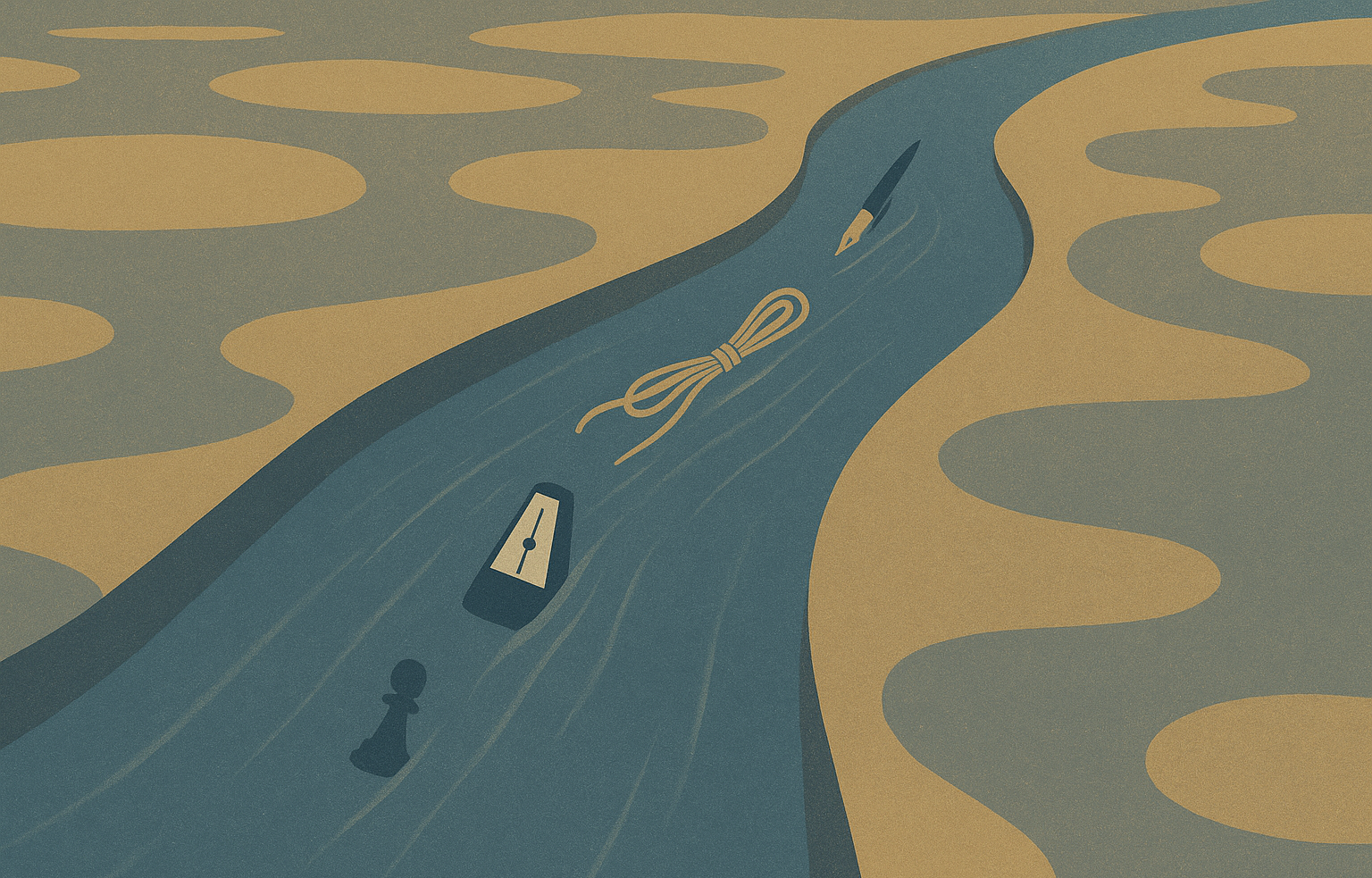
If there is one recurring image in the Tao Te Ching, it is water. A central chapter says that the highest good resembles water because it benefits all things and settles where others do not want to go. It is soft enough to seep through cracks, yet over time it carves canyons and wears down stone.
This is the book’s argument for softness. It praises the newborn infant, weak in bones and muscles yet completely alive and flexible. It praises the “uncarved block,” natural and untouched by cleverness. The point is not to become passive, but to understand that rigid strength breaks while flexible strength survives. The text explicitly links stiffness with decay and yielding with vitality and growth.
Practically, this shows up in how you handle conflict. When attacked, the text suggests, you do not automatically meet hardness with hardness. You can step aside, give way, let the other exhaust themselves. This can mean defusing an argument by listening, refusing the bait instead of matching volume. It can mean changing course in your career because clinging to a failing plan would be ego, not courage.
There is also a quieter implication for energy. Much of our fatigue comes from mental rigidity: insisting that the world match our plans. The Tao Te Ching invites you to conserve energy by giving up unnecessary resistance. You still act, but you stop arguing with reality in your head all day.
Leading by stepping back
A surprising amount of the Tao Te Ching is about leadership. It was likely written in a time of political upheaval, and many verses address rulers directly. The advice is the opposite of heroic, charismatic leadership.
We are told that the best leader is one whose presence is barely felt. When the work is done and the task accomplished, people look around and feel they did it themselves. In another verse, the text warns that when leaders flaunt their love of power and rare possessions, theft and unrest follow. The sage leader keeps their own desires small, their lifestyle simple, their ego quiet. By not competing, they leave space for others to flourish.
This extends into how decisions are made. Rather than rushing to fix or control, the wise person waits, pays attention, and acts only when the time is ripe. One chapter uses the image of cooking a small fish: if you poke it too much, you ruin it. Governing a large country, or managing a large team, works the same way—too much interference tears things apart.
For personal leadership, the same pattern holds. The book speaks of ruling the self with the same language it uses for ruling a state. If you constantly crack down on yourself with harsh discipline, you generate inner rebellion. If you treat yourself the way the sage treats the people, with patience and respect for your own rhythms, you create conditions for genuine order. The instinct behind Energy Management, Not Time Management has a similar flavor: you stop trying to bully yourself through the day and start leading yourself more gently and intelligently.
Emptying out: humility, mystery, and doing less
Another persistent theme is emptiness. The Tao Te Ching praises empty bowls, the hole in the hub of the wheel, the space in a room. The usefulness of things, it points out, often comes from what is not there. We work with material stuff, but it is the absence—the gap, the opening—that lets us actually use it.
Applied inwardly, this becomes a teaching on humility and not‑knowing. The sage is described as dull, simple, even foolish by worldly standards. They do not stuff their minds with trivia or chase status. They cultivate what the text calls “knowing not‑knowing,” an awareness of the limits of their own understanding. In another verse, there is a sharp contrast between those who talk a lot and those who truly grasp the Tao, a deliberate jab at our love of clever opinions.
The book encourages you to empty yourself of constant cravings and rigid views. Desire is not demonized, but restless grasping is. By wanting less, you become tougher to manipulate and easier to satisfy. Free attention returns. You notice the ordinary world again. There is a strong overlap here with mindfulness practice and with reflecting on your own core values rather than inherited ambitions, the kind of work outlined in Understanding Core Values.
Emptiness also underlies the text’s strange confidence in doing less. One striking verse contrasts the pursuit of knowledge, where something new is added every day, with the pursuit of the Tao, where something is dropped every day. You move not toward maximal optimization but toward a simpler, cleaner life where fewer things pull on you.
The honest caveat
For all its elegance, the Tao Te Ching is hard to pin down. We do not know exactly who wrote it, whether “Lao Tzu” was a single person, a title, or a later attribution. The text itself is brief, poetic, and full of metaphor. That is part of its charm, but it also means interpretation does most of the work. Two translators can make the same verse sound like a political manifesto, a therapy manual, or a mystical riddle.
Historically, some have used the book to justify quietism, telling people to accept unjust conditions because “going with the flow” is spiritual. Others lean so far into its praise of non‑action that they miss how often it also criticizes cruelty and honors compassion. If you read it too literally, you risk turning a nuanced orientation toward life into a slogan for passivity. There is also no modern research in the background. Any alignment with psychology or performance science is something we bring to the text, not something it is claiming for itself.
Where to start
The Tao Te Ching is nonlinear, so you can open it anywhere and get something. Still, some chapters are an easier entry point. Start with the first ten. They introduce the unnameable Tao, the idea of emptiness, and early sketches of wu wei without too much political context. After that, skip to the water imagery: chapters often numbered 8 and 78 in many translations. They capture the paradox of softness and strength in a memorable way.
On a second pass, spend time with the leadership‑focused verses about rulers who take little credit and interfere rarely, typically in the late teens and 60s of standard editions. Those are where the book’s abstract ideas crystallize into daily decisions about how you deal with power, status, and control.
To read the Tao Te Ching well is to let it sand down your need to force things, until your life begins to feel more like water finding its own level.
The softest thing in the universe overcomes the hardest thing in the universe. — Lao Tzu