Stoicism for Modern Life
Stoicism is not emotional numbness. It is the quiet skill of sorting what you can control from what you cannot, then putting your effort in the right place.
You check your messages and feel your chest tighten. A blunt email, a delayed train, and a breaking headline hijack your mood before you finish breakfast. Stoicism offers one simple habit here: sort what is up to you from what is not, then spend your energy only on the first group.
Stoicism is often misunderstood as pretending not to care. In practice, it is something simpler and more useful: noticing what is not up to you, choosing where your effort actually matters, and then acting there with full heart.
What Stoicism Really Asks of You
A lot of modern advice tells you to “stay positive” or to “not let things get to you”. You know that does not work. You still feel the rush of frustration when someone cuts you off in traffic or when a project falls apart because someone else dropped the ball.
Stoicism does not ask you to feel nothing. It asks you to make a small, sharp distinction every time you feel stirred up:
- What here is truly up to you?
- What here is not?
Epictetus called this the dichotomy of control. Your judgments, choices, and efforts are in your control. Other people, outcomes, and most events are not.
You can test this in tiny scenes from your week. You spill coffee on your shirt just before a meeting. The stain, the time, the fact that it already happened, all of that is outside your control. The part that is up to you is whether you swear under your breath for ten minutes, arrive late because you kept fussing with it, and then spend the whole meeting replaying the moment. Or whether you change if you can, arrive on time even if you look less polished than you hoped, and give your full attention to the conversation.
Same event, different use of control.
The Control Filter: A Stoic Tool for Daily Stress
You already have a mental habit of replaying problems. You lie in bed and re-run the awkward meeting, or you script arguments you hope never to have. Your mind builds detailed scenes around things that are long over or have not started yet.
You can keep that habit. You just point it in a different direction.
Use what you might call a control filter. Anytime you feel a spike of stress, you quietly run the situation through three quick questions:
- What part of this is entirely outside my control?
- What part is partly in my control?
- What part is fully in my control right now?
Notice what this does. Instead of treating your reaction as one big cloud of “bad”, you sort it. You stop acting as if your thoughts, feelings, other people, and random events all sit in one pile.
Take a stressful email as an example. The message has already been sent, so you cannot control that it exists. The sender’s mood, their history, and whatever pressure they are under are also outside your control.
Partly in your control is how the relationship unfolds from here. You can choose to ask clarifying questions, to pick up the phone instead of escalating by email, or to suggest a short meeting. You do not control whether they accept that invitation, but you do shape the tone you bring.
Fully in your control is your next move. Do you fire back something passive aggressive, or do you step away for two minutes, breathe, and then write a clearer, calmer response that asks for the specifics you need?
Stoicism Is Not Emotional Numbness
You might push back on all this: “If I stop worrying about what I cannot control, will I become detached or lazy? What if I stop caring about people?”
Look at your own experience. Think about a time when you were overwhelmed by a situation that you could not change. Maybe a loved one was seriously ill. Maybe a company decision upended your team. In those moments, the panic and the overthinking did not help you show up better. They just drained you.
Now think of a different pattern. Someone you care about is going through something hard, and you know you cannot fix it. You sit with them, make a meal, or drive them to an appointment. You feel heavy and sad, but you do something.
That second pattern is closer to Stoicism.
Stoicism does not tell you to feel less. It tells you to stop negotiating with reality. You feel the full weight of what is happening, then you stop asking “Why is this happening to me?” and start asking “Given that this is happening, what kind of person do I want to be here?”
This is where Stoicism sometimes sounds harsh. You read lines from Meditations, where Marcus Aurelius reminds himself that people will be unjust, that you will lose things you love, that you will die. It can sound cold on the surface.
Look a layer deeper. He is not telling himself not to care. He is reminding himself not to be surprised. When you stop being shocked by the basic facts of life, you free up energy to respond with some grace.
Contrary to a lot of self help advice, you do not always need to “reframe” a situation into something positive. Sometimes an event is simply painful or unfair. Stoicism allows you to say, “This is bad, and it is here.” You do not force a silver lining. You put your focus on what you will do next in a world where this bad thing exists.
That is not numbness. That is sober courage.
Using Stoicism to Protect Your Focus
Your attention is pulled in more directions than at any other point in history. News, social feeds, notifications, work chat, family group messages, endless options for what to do with any free minute. You might think your problem is distraction, but it is often something upstream: a belief that you must react to everything you see.
Stoicism cuts that belief in half.
You do not control what appears in front of you. You control how much of your day you give to it.
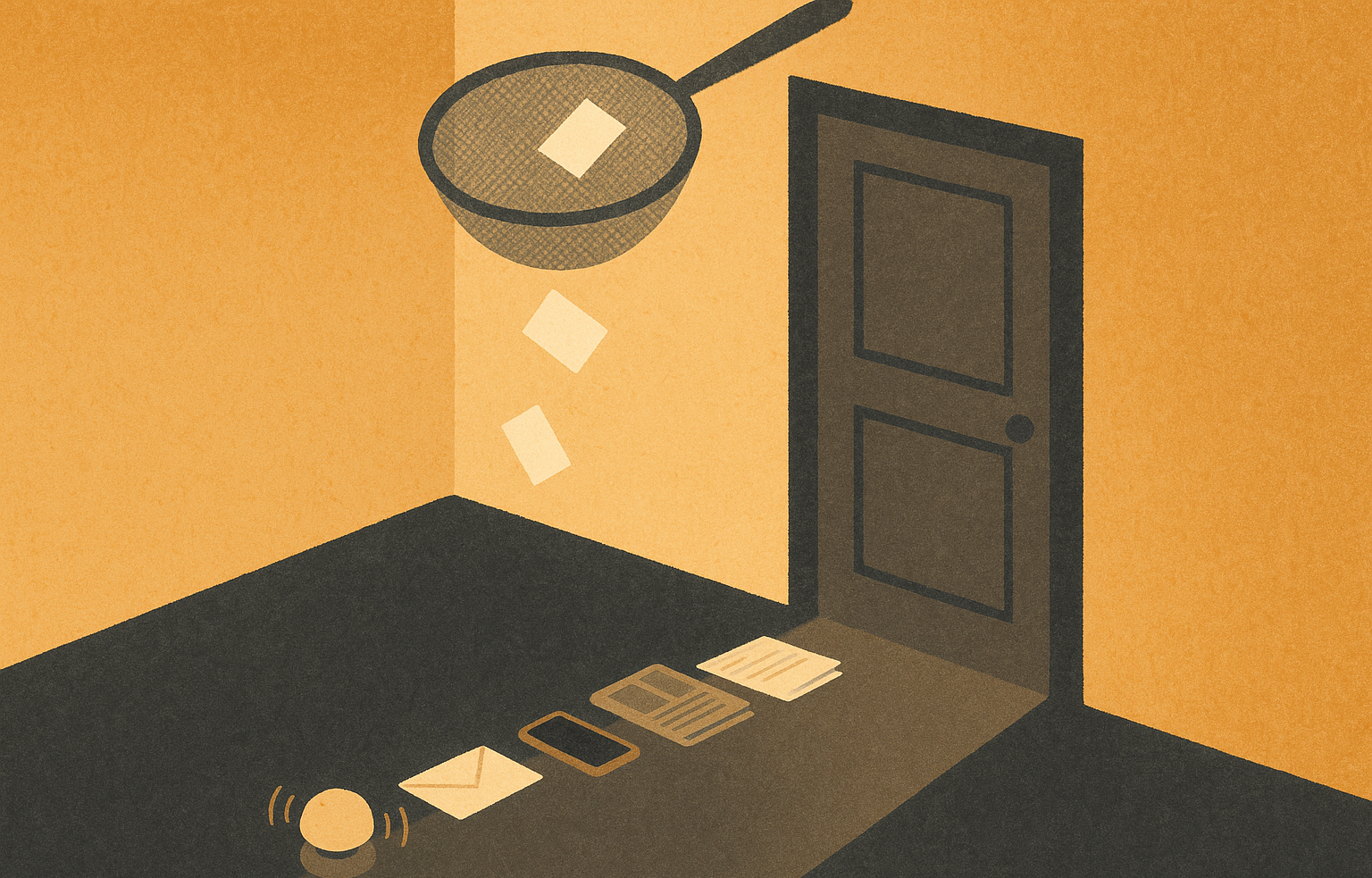
Imagine your day as a small room with a single door. You cannot control who walks up to the doorway and knocks. Emails, alerts, invitations, worries, all line up outside. Your control is over the handle. You decide which knocks you open the door for, how long you let them stay, and which ones you simply watch come and go.
Most of your stress comes from acting as if the door is already wide open. Every notification barges straight in. Every headline drags a chair to the middle of the room. Every request sits down and starts talking before you have even looked up.
A Stoic approach is to keep your hand near the handle. You still care about what is happening in the world and in other people’s lives. You just stop granting everything the same access.
You can build this into your day in simple ways:
- Set response windows. You decide that you will check news or social feeds at specific times, not whenever your phone buzzes.
- Name your real work. For each day, you choose one or two tasks that rely heavily on your effort and attention, and you protect time for them.
- Practice deliberate ignoring. When a message or link appears that you cannot meaningfully act on today, you consciously say, “Not mine right now.”
The inner move is always the same. You ask, “Is this in my control in this moment?” If the answer is no or not much, you shift your focus back to what is.
This is not about becoming self centered. It is about sequence. You attend to the things where your impact is clear before you attend to the things where your impact is vague.
Turning Setbacks Into Training
You are going to keep facing events that you would never choose. Illness, loss, unfair judgment, projects that collapse for reasons outside your reach. You do not have to pretend these things are good.
Yet there is a harder Stoic idea that can quietly strengthen you: treating setbacks as training.
Ryan Holiday popularized this as “the obstacle is the way”. The basic thought is simple. Since you cannot avoid difficulty, you might as well use it to sharpen specific qualities in yourself.
You can apply this without any slogans. The next time something goes wrong, you can ask:
- If I view this as training, what is it training in me?
- Patience?
- Courage?
- Clarity under pressure?
- The ability to let go?
Picture one of those old training gyms where fighters used sandbags and heavy ropes instead of machines. The equipment does not care who uses it. It just provides resistance. How you engage with it determines whether you get stronger or just tired.
Your setbacks work the same way. A delayed payment can be pointless frustration, or it can be practice in calm follow up. A harsh comment can be pure sting, or it can be material for learning how to respond without rushing to defend yourself.
This approach has a limit. Some events are so severe that talk of “training” feels disrespectful to the pain involved. Stoicism does not demand that you be grateful for every disaster. It offers you a tool that you can choose to use when it helps.
The contrarian part is this: you might actually grow more from the things you did not want than from the things you planned. Only if you decide to treat them as material, not as pure interruption.
One Small Step Today
Pick one situation that is currently weighing on you. It might be a relationship tension, a work issue, or a wider worry that you keep revisiting. On a piece of paper, draw a line down the middle. On the left, write “Not up to me”. On the right, write “Up to me”. Take five quiet minutes to list details of that situation into each column, then circle one item from the “Up to me” side and take a concrete action on it before the day ends.